
India’s education system is going through steady changes as the National Education Policy (NEP) moves deeper into classrooms and campuses in 2025. The focus is slowly shifting away from fixed textbooks,
memory-based exams, and rigid degree paths. Instead, learning is being shaped around skills, flexibility, and real-world use of knowledge.
From artificial intelligence in classrooms to new assessment tools, school upgrades, flexible university courses, and language reforms, the NEP updates are touching almost every level of education. Together, these changes aim to prepare students better for future jobs while also making learning more practical and inclusive.
Below are some major changes brought under NEP in 2025:
AI Becomes Part Of Everyday Learning
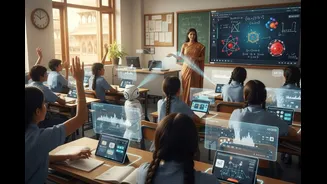
Artificial Intelligence is now being added step by step into school and college education. Union Education Minister Dharmendra Pradhan recently said AI can help solve long-standing problems in education by making learning more open and equal for students across backgrounds.
At the school level, AI is being introduced as a skill-based subject, especially for senior classes. In colleges and universities, courses are being updated so students learn about new technologies that matter in today’s job market.
During a recent discussion, officials shared that AI tools are also being explored for teaching methods and assessments, helping teachers personalise learning for students. The goal is to support both learners and educators using technology, without replacing the human role in education.
Schools Move Away From Memory-Based Exams
The Central Board of Secondary Education (CBSE) is working on a digital platform that will change how school exams are designed. Instead of testing how much students can memorise, the focus will be on how well they understand and apply concepts.
This platform will allow teachers to create better questions, review quality, and track learning outcomes. It will support both regular tests and final exams. The move follows NEP 2020’s push to reduce exam pressure and make education more balanced. Once launched, the system is expected to help teachers design fairer and more meaningful assessments across CBSE schools.
PM SHRI Schools Focus On Better Facilities
The PM SHRI scheme aims to turn selected schools into model institutions that reflect NEP values. Around 14,500 schools across India are planned to be upgraded with better buildings, teaching tools, and digital learning support.
In October, Kerala joined the scheme after earlier concerns. The state clarified that joining PM SHRI does not take away its power to design textbooks or decide its syllabus.
The scheme focuses on hands-on learning, skills, and overall student growth. These schools are expected to set examples for other institutions, while still allowing states to keep control over their education systems.
Universities Adopt Flexible Degree Paths
Banaras Hindu University (BHU) reviewed how it is rolling out NEP changes, especially the new four-year undergraduate courses. Students can now choose honours or honours with research, along with flexible major and minor options.
The university is allowing students to switch subjects after the first year in some cases and is improving internships, online courses through SWAYAM, and skill-based classes.
Credit limits per semester have been clearly defined, and exit options like certificates or diplomas remain in place. The idea is to give students more choice while keeping academic standards strong.
Language Rules Change In Schools
Maharashtra has started implementing NEP 2020 by making Hindi a compulsory third language for Classes 1 to 5 in Marathi and English medium schools. Earlier, these schools taught only two languages.
The change will begin from the 2025–26 academic year and follows the NEP’s three-language formula. The state is also rolling out the new 5+3+3+4 school structure, which divides schooling into clear stages from early years to senior secondary. Officials say the move is meant to strengthen language learning from an early age and bring uniformity across schools.