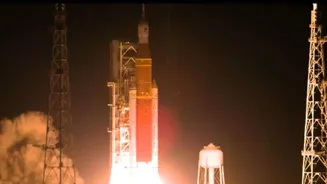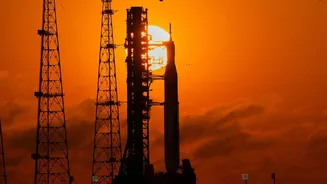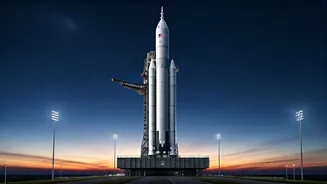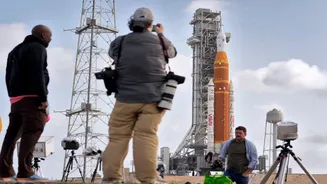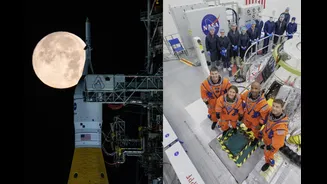





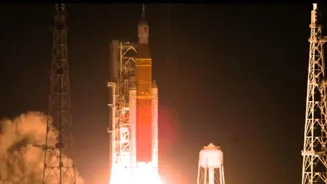


Humanity finally began its long-awaited return to the lunar vicinity early on Thursday. NASA’s Artemis II mission, powered by the 32-storey Space Launch System (SLS) rocket, successfully lifted off from
Florida’s Kennedy Space Centre. While the sight of four astronauts—Reid Wiseman, Victor Glover, Christina Koch, and Jeremy Hansen—climbing into the Orion capsule evoked memories of the Apollo era, the mission profile is fundamentally different. Unlike the 1960s missions that darted for the Moon almost immediately, Artemis II is currently “loitering” in a high Earth orbit, a strategic 24-hour pause that serves as the ultimate safety check.
Why is the crew staying in Earth orbit for 24 hours?
The decision to keep the Orion spacecraft in a high elliptical Earth orbit for the first day is a deliberate “circuit breaker” designed for crew safety. During this period, the spacecraft reaches an apogee of roughly 1,200 nautical miles, nearly five times higher than the International Space Station. This phase, known as the High Earth Orbit (HEO) period, allows the mission controllers in Houston to verify every critical system while the crew is still close enough to Earth to perform an emergency “direct return” if something fails.
The primary objective during these first 24 hours is to test the Environmental Control and Life Support System (ECLSS). For the first time, Orion’s cabin is being pressurised and scrubbed of carbon dioxide by a live crew rather than sensors and test dummies. This “checkout” period is the only window NASA has to ensure the spacecraft can sustain four humans for a 10-day journey into the deep-space radiation environment. If the life support systems show even a minor anomaly, the mission can be aborted before the final engine burn commits the crew to a four-day journey toward the Moon.
What is the ‘space toilet’ test and why does it matter?
Among the most vital—and least glamorous—tests occurring during this 24-hour window is the verification of the Universal Waste Management System (UWMS), or the “space toilet”. While it may sound trivial, a malfunctioning waste system in a confined capsule is a mission-critical failure. On Artemis II, the crew is testing a more compact, reliable, and gender-neutral design compared to previous versions.
In the microgravity of space, fluid dynamics and air filtration are incredibly complex. The UWMS uses a fan-driven suction system to ensure waste is properly contained and odours are filtered out. Testing this system while still in Earth orbit ensures that any mechanical clogs or filtration issues are identified early. For the astronauts, a functional waste system is not just a matter of comfort; it is essential for maintaining a sterile and habitable environment during the high-stakes lunar flyby.
How will the crew practice ‘manual parking’ in space?
During this initial orbit, the crew is also performing a high-precision manoeuvre known as Proximity Operations. After separating from the Interim Cryogenic Propulsion Stage (ICPS)—the rocket’s upper stage—Commander Reid Wiseman will take manual control of Orion. Using the spent ICPS as a target, the crew will practice “station-keeping”, essentially hovering and moving the spacecraft in relation to the floating rocket stage.
This exercise is a dress rehearsal for Artemis III, where astronauts will need to dock Orion with a lunar lander in high orbit around the Moon. By practising these manual handling qualities now, the crew is validating that Orion’s software and thrusters respond exactly as predicted. This demonstration is the final hurdle before the spacecraft performs the Trans-Lunar Injection (TLI) burn—the massive engine fire that will slingshot them out of Earth’s grasp and toward the lunar far side.
Who is on the mission and what records will they break?
The Artemis II crew is a historic ensemble, representing a broader cross-section of humanity than the Apollo missions. Victor Glover is set to become the first person of colour to leave low Earth orbit, while Christina Koch will become the first woman to do so. Canadian Space Agency astronaut Jeremy Hansen is the first non-American to venture towards the Moon, and Commander Reid Wiseman is the oldest person to embark on such a journey.
By the time they return, the crew will have travelled more than 400,000 kilometres from Earth, venturing roughly 4,600 miles beyond the far side of the Moon. This “free-return” trajectory ensures that even if Orion’s main engine were to fail after the TLI burn, the Moon’s own gravity would act as a natural slingshot, pulling the capsule around and sending it safely back toward Earth. It is a mission built on redundant safety, ensuring that when humans finally land on the lunar surface in 2028, every bolt, sensor, and system has been tested to its limit.