







India’s biggest cities are heading into summer 2026 with a familiar problem — not enough reliable water when residents need it most. Reports suggest that metros like Delhi, Bengaluru, Chennai and Hyderabad
are already among the world’s most water-stressed urban centres, pointing to a crisis that is no longer seasonal, but structural.
For urban residents, this means one thing: water supply will likely remain uneven, expensive, and uncertain. Governments are rolling out summer action plans and emergency measures, but much of the burden — from storing water to paying for tankers — continues to fall on households.
Delhi: A Capital Tunning On Tankers
Delhi’s summer preparedness plan may look robust on paper — with over 900 tankers, pipeline repairs, and contingency measures rolled out — but the city continues to function on what is essentially a parallel water economy.
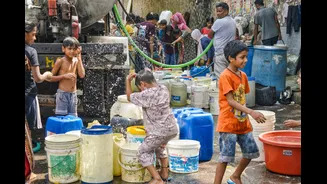
Recent reports show that while official supply systems exist, a significant number of households still depend on private tankers, borewells, or informal arrangements, especially in unauthorised colonies and outer districts. A city audit highlighted how residents in some areas end up paying disproportionately — in some cases, up to 15% of household income just to secure water.
At the same time, Delhi remains categorised among cities facing “extremely high water stress”, where demand is dangerously close to available supply.
What makes the situation more fragile is Delhi’s dependence on external river sources like Yamuna and Ganga canals, and inter-state agreements. Any disruption — whether political, environmental, or infrastructural — quickly translates into shortages on the ground.
What Delhiites Should Expect: Water access in Delhi is not just about availability, but where you live. Planned colonies may see relative stability, but large parts of the city will continue to rely on tankers, stored water, and careful daily planning.
Bengaluru: A City Still Recovering From Crisis
Bengaluru enters summer 2026 with a sense of urgency shaped by last year’s crisis, but the deeper issues remain unresolved.
Authorities have identified 448 high-risk water-stressed pockets and announced a Rs 10 crore action plan to manage supply. Yet, scientific assessments paint a more worrying picture. An IISc-linked study flagged groundwater depletion across at least 65 wards, many of them in dense residential and apartment-heavy zones.
The city’s dependence on borewells and tanker networks has created a fragile system. When groundwater drops, tanker demand spikes, and prices follow. This has effectively turned water into a market-driven commodity, where access depends on affordability.
Compounding the issue is pollution in feeder systems like the Vrishabhavathi river, raising concerns about future reservoir quality and sustainability.
What Bengalureans Should Expect: Even if taps don’t run dry, cost and reliability will fluctuate. Apartment residents, in particular, should expect continued dependence on tankers, and potentially higher monthly maintenance bills.
Hyderabad: Fast-Growing City, Slow-Moving System
Hyderabad’s water story is less dramatic — but quietly concerning.
The city’s supply infrastructure has remained largely unchanged since 2012, even as population and urban sprawl have surged. Current projections indicate a possible shortfall of over 200 MGD, highlighting a widening gap between demand and supply.
This gap is already visible in newer residential clusters and peripheral areas, where pipeline connectivity lags behind construction growth. As a result, many households are increasingly dependent on tankers and groundwater extraction.
There have been efforts to improve resilience — including lake rejuvenation and rainwater harvesting — but experts caution that these are incremental solutions in the face of rapid urban expansion.
What Hyderabadis Should Expect: If you live in central, established areas, supply may remain stable. But in newer neighbourhoods, water reliability may depend more on private arrangements than public systems.
Mumbai: A City With Water But Low Access
Mumbai’s situation stands apart in one key way — the city is unlikely to run out of water this summer. Its reservoir network typically provides a buffer that many other metros lack.
But this does not translate into equal access.
The real issue lies in distribution inefficiencies, ageing pipelines, and localised shortages. Even in years of adequate storage, several neighbourhoods — especially informal settlements and rapidly growing suburbs — continue to rely on tankers and shared supply points.
Mumbai also exemplifies a growing urban paradox: a city that faces flooding during monsoon, but uneven supply in summer — largely due to poor storage, leakage, and infrastructure constraints.
Additionally, rising urban demand and industrial usage are putting increasing pressure on existing systems, even if headline reservoir levels appear comfortable.
What Mumbaikars Should Expect: Water may not disappear — but timing, pressure, and consistency will remain issues. Storage tanks and daily scheduling are still part of life in many parts of the city.
Chennai: Living With The Memory Of ‘Day Zero’
Chennai’s water system is shaped by one defining reality — it is highly vulnerable to rainfall patterns.
Even after the 2019 ‘Day Zero’ crisis, which forced the city to rely almost entirely on tankers, improvements in infrastructure have not eliminated the core risk. The city continues to depend heavily on monsoon recharge, reservoirs, and groundwater.
Recent analyses continue to list Chennai among India’s most water-stressed metros, with experts warning that a weak monsoon can quickly push the city back into crisis mode.
What has changed is behaviour. Households, apartment complexes, and institutions are now more likely to invest in rainwater harvesting, storage systems and water reuse.
But these are adaptive responses, not systemic fixes.
What Chennaiites Should Expect: Water availability may seem stable — until it isn’t. Chennai remains one bad monsoon away from severe shortages, making conservation a necessity, not a choice.