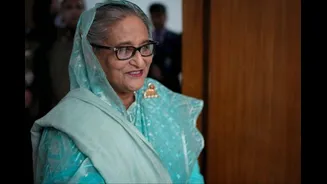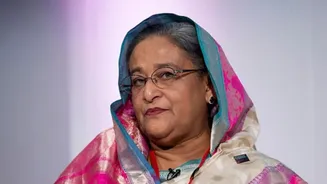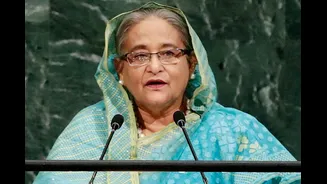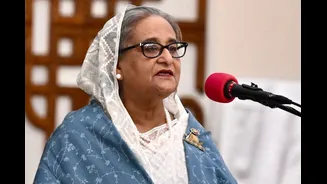







Dhaka is witnessing a fresh wave of violence as December approaches—the month when its former prime minister Sheikh Hasina has vowed to return to the political spotlight, “come what may”. At least 50 crude
bomb blasts have been reported across the capital over the past few days, alongside a series of arson attacks targeting public transport, raising fresh concerns over the deteriorating law and order situation.
According to the Dhaka Tribune, “at least 8 buses have been set on fire and more than 50 crude bomb explosions have been reported at different locations in the capital over the past few days. At least 8 bombs exploded between Friday (November 6) evening and late at night, in Adabor, Shahbagh, Khilgaon, the Airport area and Kalshi in Mirpur”.
The latest explosion came on Monday, coinciding with reports that Hasina had sought a Bangladeshi passport to facilitate her return to Dhaka. Miscreants detonated a crude bomb on the road outside the Chief Metropolitan Magistrate (CMM) Court in the capital. An unexploded crude bomb was also recovered from the spot, adding to concerns over the frequency and spread of the attacks.
In a related development, 27-year-old Jabir Salehin Dipu was among two activists of the banned Bangladesh Chhatra League, the student wing of the Awami League, detained following a series of explosions.
The Daily Star reported another explosion on a road near the Teacher-Student Centre (TSC) at Dhaka University. Describing the police response, the newspaper quoted a police personnel as saying, “The sub-inspector said the two alleged attackers were being held at the police station. A bag was also found at the site, he said, adding that the area has been cordoned off and police are waiting for the bomb disposal unit to arrive.”
Another crude bomb exploded in front of the Criminal Investigation Department (CID) headquarters in Malibagh, Dhaka, on Sunday.
The violence has not been limited to crude bomb attacks. A bus operated by a private company was set on fire beneath the metro rail station in Dhaka’s Farmgate area on Monday evening. Visuals of the burning bus moving towards the metro station have since gone viral on Bangladeshi social media, triggering widespread concern. The fire also forced the adjoining metro station to suspend operations for around 40 minutes.
POLITICAL TEMPERATURE RISES AHEAD OF DECEMBER
The spate of attacks comes at a politically sensitive moment for Bangladesh. With December drawing closer, Awami League supporters appear to be stepping up their political activity in anticipation of Sheikh Hasina’s possible return. The BNP-led government has blamed the ongoing violence on Awami League sympathisers, while the latter have accused the ruling establishment of framing their activists.
The competing allegations have added tension to an already volatile political atmosphere, with the question of Hasina’s return increasingly becoming a flashpoint between the two sides.
Hasina’s legal representatives at London-based Matrix Chambers have written to Preeti Rahman, acting high commissioner at Bangladesh’s embassy in Delhi, seeking the issuance of her “Bangladeshi passport and National Identity Card”.
The request has brought the question of Hasina’s return into sharper focus, particularly given the diplomatic and legal complications surrounding her stay in India.
However, Bangladesh’s State Minister for Foreign Affairs Humaiun Kobir had dismissed the possibility of Hasina returning through the normal route last week, making it clear that Dhaka continues to seek her extradition from India. “We want Hasina to be handed over…She is a fugitive. There is an active extradition treaty between Bangladesh and India,” Kobir said.
With the political contest between the BNP and Awami League intensifying and a spate of explosions and arson attacks unsettling Dhaka, the coming weeks could prove crucial for Bangladesh’s fragile political climate.