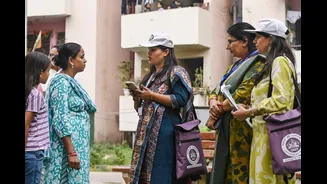








Census 2027: From caste and religion to Aadhaar, bank accounts and even the place where you received your Covid-19 vaccination, the Centre has notified a list of 40 questions that respondents will be asked
during the population enumeration phase of Census 2027.
The questionnaire, notified by the Registrar General of India, covers a wide range of information about individuals — including their education, employment, migration, family details, languages, disability status and access to identity documents.
The biggest headcount in India will also mark a significant change: caste details will be collected as part of the Census for the first time. The questionnaire is not expected to provide a pre-set list of castes. The order from Registrar General of India Mrityunjay Kumar Narayan notified questions such as whether the person belongs to a Scheduled Caste or a Scheduled Tribe and their caste.
The population enumeration exercise will begin from September 1 to September 30 in Ladakh and snow-bound non-synchronous areas of Jammu and Kashmir, Himachal Pradesh and Uttarakhand. Respondents in these areas will have the option of self-enumeration from August 17 to 31, before the house-to-house exercise begins.
For the rest of the country, population enumeration will take place next year.
What You Would Be Asked?
The questions cover everything from basic personal details to employment, migration, family and identity documents.
- Name of the person
- Relationship to the head of the household
- Sex
- Date of birth and age — in completed years
- Current marital status
- Age at marriage — in completed years
- Spouse’s name
- Nationality, as declared
- Religion
- Scheduled Caste (SC)/Scheduled Tribe (ST)/Caste
- Father’s particulars
- Mother’s particulars
- Disability
- Mother tongue and other languages known
- Literacy and digital literacy status
- Status of attendance in an educational institution
- Highest educational level attained and stream/discipline
- Whether the person worked at any time during the last year
- Category of economic activity
- Occupation
- Nature of industry, trade or service
- Class of worker
- Non-economic activity — for marginal, semi-marginal and non-workers
- Whether seeking or available for work — for marginal, semi-marginal and non-workers
- Travel to place of work
- Birthplace
- Place of last residence
- Reason for migration
- Duration of stay in the village/town since last migration
- Permanent residential address
- Number of children surviving at present — for currently married, widowed, divorced and separated women
- Number of children ever born alive — for currently married, widowed, divorced and separated women
- Number of children born alive during the last one year — for currently married women
- Place of Covid-19 vaccination
- Total number of bank accounts
- Mobile number, if available
- Aadhaar number, if available
- Voter ID number, if available
- Passport number, if an Indian passport holder
- Availability of a driving licence
Why is Census 2027 different?
The upcoming Census will be the first Indian Census to collect caste information as part of the population enumeration exercise. The decision to include caste was taken by the Cabinet Committee on Political Affairs, chaired by Prime Minister Narendra Modi, in April 2025.
“In exercise of the powers conferred by sub-section (1) of section 8 of the Census Act, 1948 (Act 37 of 1948), the Central Government hereby instructs and directs that the census officers may, within the limits of the local area for which they have been respectively appointed, ask all such questions of all persons residing within such limits, subject to the items enumerated below, for collecting information through the Household Schedule in connection with the Census of India 2027,” a notification from Registrar General of India said.
The questionnaire also goes beyond traditional demographic information. It seeks details on digital literacy, employment patterns, migration, bank accounts and identity documents, giving the government a broader picture of India’s population.
The exercise is also set to be fully digital, marking a major technological shift in the country’s decennial population count.
The population count is being preceded by the House Listing and Housing Census (HLO) phase, which is scheduled to continue until September 30.
Enumerators have been visiting houses and buildings in several states and Union territories since April 16. During this phase, officials are collecting information about houses, household facilities, the head of the household and ownership status.
The Census was originally scheduled for 2021 but was postponed because of the Covid-19 pandemic.
The Union Cabinet has approved Rs 11,718 crore for conducting the Census.