




The requirement for a fifth-generation fighter aircraft has now become an operational necessity for the Indian Air Force (IAF), with momentum building around the proposal to procure such fighter jets.
A decision is expected after the finalisation of the Rafale deal from France.
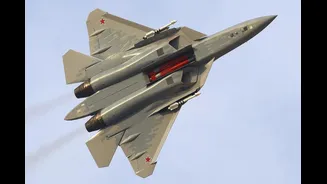
At present, Russia’s Sukhoi Su-57 is considered the front runner, primarily due to cost considerations and India’s existing experience operating the Sukhoi Su-30MKI, making the technology absorption and integration smoother with the Russian platform.
“We don’t have many options, and we have our criteria set. Whoever gives us more leverage, we decide in their favour,” a senior defence official privy to the developments told CNN-News18, while clarifying that no final decision has been taken.
At a time when China has reportedly test-flown sixth-generation fighters and is planning to supply fifth-generation aircraft to Pakistan, Indian forces view a fifth-generation capability as critical to meet emerging operational requirements.
India’s indigenous Advanced Medium Combat Aircraft (AMCA) programme has gained momentum, but it remains several years away from production. In the interim, the induction of Dassault Rafale jets and the HAL Tejas Mk1A variant is expected to address depleting squadron numbers.
The US-made Lockheed Martin F-35 Lightning II remains an option. However, concerns persist regarding higher acquisition costs and possible restrictions on the integration of Indian-origin weapons.
On the other hand, Russia has proposed a comprehensive package centred on the export variant, the Su-57E, offering weapons, licensed production, and what it describes as “unrestricted” transfer of technology. Moscow maintains that the platform meets established fifth-generation criteria, highlighting its composite-heavy structure, radar-absorbent coatings and internal weapons bays to enhance stealth.
Meanwhile, the Defence Acquisition Council, chaired by Defence Minister Rajnath Singh, has approved the procurement of 114 additional Rafale fighter jets for the IAF. Sources have said that cost negotiations are currently underway, with discussions focused on ensuring flexibility to integrate Indian weapons on the platform.
The process is expected to take a few months and may be finalised in the next fiscal.
All About Su-57E Fighter Jets
Russia claims the Su-57E meets all established fifth-generation criteria, citing its composite-heavy structure, radar-absorbent coatings, and internal weapons bays designed to enhance stealth. The fighter’s design prioritises reduced detectability even during active radar use, a capability Russia says has been validated through real combat operations.
The aircraft features long supersonic endurance, a high-automation cockpit with AI-assisted decision support, and an integrated countermeasure suite. The onboard AESA radar reportedly has a detection range of 240 kilometres, complemented by an IRST system and omnidirectional optical sensors for wide-area situational awareness.