




The reunion of the Bharatiya Janata Party (BJP) and the Shiromani Akali Dal (SAD) ahead of the 2027 Punjab assembly elections may look like a return to an old political arrangement. However, the circumstances
in which the two parties have come together again are very different from those in which they first built their partnership.
For the BJP, the Akali Dal offers something it has struggled to establish on its own in Punjab—a regional political network with roots among rural voters, sections of the Sikh electorate and the farming community. For the SAD, the alliance offers an opportunity to recover lost political ground, regain access to the NDA’s national platform and challenge the perception that it has become a marginal force in its own state.
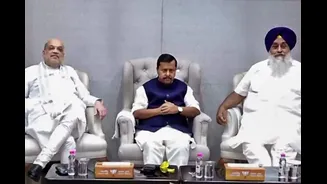
Announcing the alliance on Tuesday, Union Home Minister Amit Shah described the Akali Dal as the BJP’s oldest ally and said, “Our relationship with Akali Dal has always been strong. Our ties go back to the Vajpayee-Advani era.” Shah also expressed confidence that the alliance would form the next government in Punjab under Prime Minister Narendra Modi’s leadership. SAD president Sukhbir Singh Badal and BJP national president Nitin Nabin were present at the announcement.
ALSO READ | BJP, SAD Back Together After Six Years. Can The Old Allies Find Common Ground Again?
But this is not simply a reunion driven by nostalgia. Both parties have been weakened by their separation, and the Aam Aadmi Party (AAP) has fundamentally altered Punjab’s political landscape since its sweeping victory in 2022. The question is whether the two former allies can use each other’s strengths to rebuild their position or whether they are merely combining two sets of political vulnerabilities.
What Does The BJP Get?
The BJP’s biggest gain from the alliance is arguably the access it gets to a political constituency where it has traditionally struggled to establish an independent presence.
The party’s support in Punjab has historically been concentrated in urban and industrial constituencies, while the Akali Dal has had a stronger base among rural voters, particularly sections of the Sikh farming community. This division of political influence was the foundation of their alliance, formalised ahead of the 1997 assembly elections.
The arrangement worked because neither party had to build an entirely new constituency. They could pool their existing support and avoid splitting votes in areas where the other was stronger.
The electoral record demonstrates how effective this formula once was. According to The Indian Express, the alliance won 93 of Punjab’s 117 assembly seats in 1997, with a combined vote share of 45.97 per cent. It went on to win 67 seats in 2007 and 68 in 2012. The latter victory was particularly significant because it allowed the SAD-BJP government to retain power for a second consecutive term—a first in Punjab since the state’s reorganisation.
ALSO READ | ‘They Come Together For Power’: Arvind Kejriwal Takes Dig At SAD-BJP Reunion As Punjab Poll Battle Heats Up
The BJP’s own performance as the alliance’s junior partner was not insignificant. It won 19 seats in 2007 and 12 in 2012, while the Akalis provided the larger rural political base.
But the BJP has been trying to move beyond this dependence. Its efforts to expand in rural Punjab have become more visible in recent years, including through its campaign against drugs. The party’s four simultaneous anti-drug yatras, launched in September 2026, were part of an attempt to build a wider political presence in the state.
The alliance now gives it a regional partner that already has a network in these constituencies. It also gives the BJP a better chance of making its campaign relevant beyond its traditional urban support base.
There is, however, a difference between having access to the Akali Dal’s political network and automatically inheriting its voters. Support extended by farmer organisations to the SAD cannot simply be counted as support for BJP candidates and it is precisely this distinction that could become important during the campaign.
What Does The SAD Get?
For the Akali Dal, the stakes are arguably more immediate. The party is not merely looking to improve its electoral tally; it needs to demonstrate that it remains a consequential political force in Punjab.
The scale of its decline is evident from the numbers. In 2017, the SAD had won 15 assembly seats. In 2022, contesting separately from the BJP, it managed just three of the 97 seats it contested, with a vote share of 18.38 per cent. The BJP, which contested 73 seats, won only two, with 6.6 per cent of the vote.
The 2024 Lok Sabha election offered little relief. The Akali Dal retained only the Bathinda seat, with Harsimrat Kaur Badal winning her constituency. Its vote share fell from 27.45 per cent in 2019 to 13.42 per cent in 2024. The BJP, meanwhile, failed to win any of Punjab’s 13 Lok Sabha seats, but secured a higher vote share of 18.56 per cent.
The figures reveal the problems plaguing the two parties. The BJP has been able to attract votes but has struggled to convert that support into parliamentary victories. The SAD, meanwhile, has seen both its electoral footprint and its traditional support base weaken.
For Sukhbir Badal, the alliance provides an opportunity to reverse that decline with the help of a national party that has a much larger organisational and electoral footprint.
There is also a national dimension. Harsimrat Kaur Badal, the SAD’s lone Lok Sabha MP, had served as a Union minister in the Modi government before resigning in September 2020 over the farm laws. Her party’s return to the NDA brings back a parliamentary ally at a time when the BJP-led government is looking to strengthen its numbers and support base in Parliament.
Seven Rajya Sabha seats from Punjab are due to fall vacant between April and July 2028, while Harsimrat’s presence in the Lok Sabha could also add to the NDA’s parliamentary strength. For the SAD, then, the alliance is not only about contesting more effectively in Punjab. It is also about restoring its place in national politics.
The BJP Is No Longer The Junior Partner It Used To Be
This is where the reunion could become complicated.
Under the old seat-sharing arrangement, the Akali Dal contested 94 of Punjab’s 117 assembly seats, while the BJP contested the remaining 23. That division reflected the relative strengths of the two parties at the time.
But the BJP’s ambitions have changed. Its vote share of 18.56 per cent in the 2024 Lok Sabha election was higher than the SAD’s 13.42 per cent, even though it failed to win a single seat. The party is unlikely to see this as a reason to simply return to its earlier position.
There is also the question of who leads the alliance. The Akali Dal is likely to want Sukhbir Badal recognised as its principal leadership face, and potentially as the alliance’s chief ministerial candidate. For the BJP, which is seeking a more prominent role in Punjab, accepting that arrangement may not be straightforward.
The old partnership worked when the BJP was comfortable playing the junior partner and the Akalis had a dominant state-level presence. Neither assumption can be taken for granted today.
Can The Akalis Bring Back The Farmers?
Perhaps the most important test of the alliance is whether it can rebuild trust among Punjab’s farming community, the very constituency whose concerns led to the break-up in 2020.
The SAD walked out of the NDA in September that year over the Centre’s three farm laws. Harsimrat Kaur Badal resigned from the Union Cabinet, and Sukhbir Badal announced that the party would no longer remain part of the BJP-led alliance. The laws were eventually repealed in November 2021, but the political relationship was not restored.
The farm-law protests were not just another policy disagreement. They became a defining political moment in Punjab, with farmers’ organisations leading a prolonged agitation against the legislation.
The political mood has shown some signs of shifting, however. The Bharatiya Kisan Union (Kadian), led by Harmeet Singh Kadian, extended support to Sukhbir Badal on November 2. Another farmers’ organisation, BKU (Lakhowal), announced its support for the Akali Dal on November 18. Both developments are significant because these organisations were associated with the farmers’ movement against the laws that caused the original split.
But their support comes with an important qualification. According to The Indian Express, farmer leaders have indicated that their backing is primarily for the Akali Dal and does not automatically extend to the BJP. They want the Akalis to continue raising farmers’ concerns even if the two parties contest together.
This leaves Sukhbir Badal with a delicate balancing act. He will have to convince farmers that the alliance does not mean abandoning the political position the party took in 2020. The BJP, meanwhile, will have to demonstrate that it understands the depth of the resentment that the farm laws generated in the state.
The alliance can bring the two parties’ organisations together. It cannot simply assume that their voters have reconciled with each other.
The Drug Issue
The BJP’s decision to make drugs a central campaign issue could be another test of how comfortable the two parties are with their new partnership.
At Tuesday’s announcement, Shah said the NDA would work to make Punjab drug-free by December 31. He also referred to a roadmap prepared after detailed discussions between Nitin Nabin and Sukhbir Badal.
The promise gives the alliance a clear campaign plank, particularly in a state where drug addiction and trafficking have remained major public concerns.
But it also creates an uncomfortable political contradiction for the Akali Dal. The party has faced years of criticism over allegations of drug-related patronage and its handling of the problem during its years in power. The BJP, too, had been part of the SAD-led government for much of that period. It cannot entirely separate itself from the record of the previous alliance.
The issue has already become a multi-party political contest. In September, BJP launched its 13-day Nasha Mukt Punjab Yatra, while the SAD started a women-led anti-drug campaign. The AAP and Congress, meanwhile, were targeting both the previous BJP-SAD government and the Centre over the continuing drug problem.
The Opposition will therefore have an obvious question: if the two parties governed together for years, why should voters believe that they can now deliver what they failed to achieve earlier?
The BJP will want to make drugs a defining issue in its campaign. The SAD will have to ensure that the same campaign does not become a reminder of its own years in government.
Can The Old Alliance Work In A Very Different Punjab?
The biggest uncertainty is whether the electoral arithmetic that worked in 1997, 2007 and 2012 can be recreated in 2027.
The AAP’s 2022 victory demonstrated that Punjab’s electorate was willing to move beyond the traditional BJP-SAD and Congress political equations. The party won 92 of the state’s 117 seats, securing a vote share of 42.01 per cent. The Congress was reduced to 18 seats.
The old alliance’s decline had begun even before the 2020 split. In 2017, the SAD-BJP combine was reduced to 18 seats, with the Congress returning to power. The controversies surrounding the SAD-BJP government’s second term, particularly the Bargari sacrilege incidents and the police firing at Kotkapura and Behbal Kalan, had damaged the Akali Dal’s credibility.
The SAD also faces challenges from rival Akali factions, including SAD (Punar Surjit) and Akali Dal (Waris Punjab De), associated with Amritpal Singh. Its organisational difficulties and internal divisions have made the task of rebuilding its traditional support base more complicated.
The BJP, meanwhile, has to contend with a state where its growing vote share has not yet translated into a significant number of seats. Its 2024 Lok Sabha performance shows that it has a constituency to build on, but also that the path from votes to victories is not straightforward.
Congress leader Sachin Pilot, reacting to the reunion, called the tie-up “opportunism” and questioned whether the two parties had resolved the differences that led to their separation. That is likely to be a line of attack for the Opposition: the parties must explain not just why they are together again, but what has changed since they parted ways.
Former BJP Punjab president Sunil Jakhar has maintained that the old alliance was about more than electoral arithmetic, describing its role in preserving Punjab’s social fabric and communal harmony after the years of militancy. That historical argument may still matter, but the new alliance will ultimately be judged on its ability to address the state’s present-day concerns.
Six years after the farm laws broke up one of Punjab’s longest-running political partnerships, the BJP and Akali Dal are back together. The question is no longer whether they can recreate their old alliance but whether they can build a new one that works for a very different Punjab.