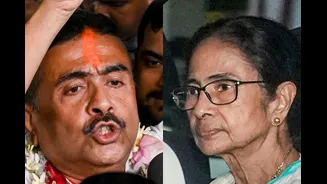








The 2026 verdict from Bhabanipur landed like a political thunderclap. In a constituency long seen as her safest ground, Trinamool Congress chief Mamata Banerjee was dealt a direct, personal defeat, once
again at the hands of Bharatiya Janata Party’s Suvendu Adhikari, once her trusted lieutenant. What made the moment even more striking was not just the loss itself, but the pattern it reinforced. This was not the first time Adhikari had taken on Mamata head-on, and won.
To understand Bhabanipur, let’s go back five years, to a charged battlefield – Nandigram.
Read More: ‘Mamata Banerjee’s Retirement From Politics’: Suvendu Adhikari On Bengal’s Bhabanipur Win
From Trusted Lieutenant To Challenger
For years, Suvendu Adhikari was one of Mamata Banerjee’s most trusted organisers on the ground. His influence in East Midnapore, particularly in Nandigram, was unmatched. He was seen as a key architect of the very movement that had propelled Mamata to power in 2011.
But by 2020, cracks had begun to show.
Adhikari’s exit from the Trinamool was as symbolic as it was strategic. When he joined the BJP, it was framed as a rebellion. He positioned himself as someone who knew the inner workings of Mamata’s system.
During that phase, one of his recurring campaign lines set the tone: “ami ekhankar chhele” (I am the son of this soil). It was a direct counter to the TMC’s attempt to paint the BJP as an external force in Bengal.
Nandigram 2021: The First Direct Clash
The real escalation came when Mamata Banerjee made a high-stakes decision, to contest from Nandigram, Adhikari’s home turf. It turned the election into a personal duel.
The campaign was intense, emotional, and charged. Adhikari leaned heavily into local identity and familiarity, repeatedly asserting he will defeat Didi right here. Mamata, on the other hand, invoked the legacy of the Nandigram movement, positioning herself as its original face.
The battle saw massive mobilisation on both sides. Booth-level fights were razor tight, narratives shifted daily, and the constituency became the focal point of national attention.
When the votes were counted, Adhikari emerged victorious, by a narrow margin, but a decisive one in symbolic terms.
Mamata Banerjee would go on to remain Chief Minister, but Nandigram left a dent. For the first time in years, she had been directly defeated in a constituency battle. And the man who did it was someone she had once mentored.
Cut To Bhabanipur 2026
After Nandigram, Adhikari’s political stature within the BJP rose sharply. He was no longer just a defector who had delivered a surprise, he became the face of the party’s Bengal challenge. More importantly, he had demonstrated a template: Mamata Banerjee could be beaten in a direct fight.
Over the next few years, the BJP sharpened that template, expanding its organisational network, consolidating votes in key pockets, and continuously targeting what it described as governance failures and corruption.
If Nandigram was a gamble for Mamata, Bhabanipur was supposed to be certainty. The constituency had long been her political comfort zone, a place where her connection with voters was seen as direct and deeply entrenched. But this time, Adhikari approached it as an opportunity to prove that no seat was beyond reach.
The campaign strategy was markedly different from 2021. Instead of relying purely on local identity, Adhikari and the BJP combined multiple threads: targeted polarisation in select pockets, outreach to urban voters, and a sustained attack on the Trinamool’s governance record.
Adhikari also leaned into the symbolism of the fight. For him, Bhabanipur was projected as a continuation of the battle that had begun in Nandigram.
This time, the margins told a clearer story. Unlike the razor-thin finish in Nandigram, Bhabanipur reflected a broader shift. Changes in voter turnout, the impact of revised electoral rolls in SIR, and a more aggressive BJP ground game all contributed to an outcome that few would have predicted in Mamata’s own bastion.
Nandigram and Bhabanipur form a rare political arc. In 2021, Suvendu Adhikari proved he could defeat Mamata Banerjee in a high-stakes, emotionally charged contest on his home turf. In 2026, he went a step further, defeating her in hers. It transforms their equation from a one-time clash into a defining rivalry in Bengal politics.