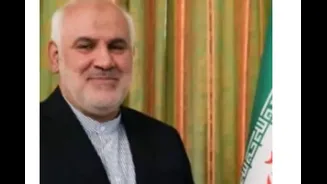








Iran’s ambassador to India Mohammad Fathali on Saturday welcomed India for opposing United Nations Human Rights Council’s (UNHRC) resolution on human rights situation in the Islamic Republic.
According
to ANI, India voted against the resolution at the UNHRC calling for increased scrutiny of the human rights situation in the Islamic Republic of Iran, aligning itself with a group of countries that opposed what they described as a selective and politically driven initiative.
India’s vote placed it among a minority of states rejecting the measure, while several others abstained. The resolution was adopted at the session by 25 votes in favour, seven against and 14 abstentions.
Following India’s vote, Iranian Ambassador to India Mohammad Fathali said in a post on X: “I extend my sincere gratitude to the Government of India for its principled and firm support of I.R. of Iran at the UN_HRC, including opposing an unjust and politically motivated resolution. This stance reflects India’s commitment to justice, multilateralism, and national sovereignty.”
I extend my sincere gratitude to the Govt. of India for its principled and firm support of I.R. of Iran at the UN_HRC, including opposing an unjust and politically motivated resolution. This stance reflects India’s commitment to justice, multilateralism, and national sovereignty. pic.twitter.com/kLFnqpNjmB
— Iran Ambassador Mohammad Fathali (@IranAmbIndia) January 24, 2026
Abdul Majid Hakeem Ilahi, Representative of Iran’s Supreme Leader, pointed out the history of India-Iran relationship that dated before the emergence of Islam and said India philosophical texts were studied in Iran over centuries.
“The Supreme Leader of the Islamic Republic of Iran always insists on good relations and collaboration between Iran and India…I hope that in Chabahar they will work nicely,” he said, referring to India’s role in the Chabahar port which has been facing US sanctions.
“The history of the relationship and collaboration between Iran and India goes to 3,000 years ago, before the emergence of Islam. Even at that time, we were using philosophical books of India… Even at the university, we studied philosophical books of India; and in mathematics, astronomy, and medicine, we were also using your civilisation, your knowledge, and we always learned through our schools the relationship between Iran and India,” he added.
ANI quoted US-based Human Rights Activists News Agency (HRANA) stating that 4,519 were killed during the wave of demonstrations, including 4,251 protesters, 197 security personnel, 35 people aged under 18 and 38 bystanders who it says were neither protesters nor security personnel.
Meanwhile, an aide to Iran’s Supreme Leader Ayatollah Ali Khamenei has acknowledged that people were killed during the recent wave of protests in Iran, but rejected allegations of large-scale state violence, calling reported death tolls “fake” and driven by foreign interests.
Iran has witnessed widespread protests since late December last year, triggered by economic hardship and rising living costs. Thae unrest has also drawn international attention, with activists and rights groups alleging a deadly crackdown by Iranian authorities claims the government strongly denies.