








Fondly remembered as the Father of the Nation, Mahatma Gandhi was a man whose words carried as much weight as his actions. Beyond leading a historic freedom movement, he was a prolific writer who chronicled
his innermost reflections, questioned the conventions of his time and articulated a vision of a nation free not only from colonial rule but also from social and moral inequalities. His writings offer a rare glimpse into the mind of a man who believed that the pursuit of truth was a lifelong endeavour. This Gandhi Jayanti, revisit five books by Mahatma Gandhi that offer a deeper understanding of his life, ideals and enduring legacy.
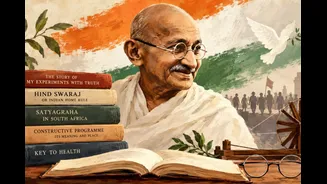
1. The Story of My Experiments with Truth
For a more intimate portrait of the Mahatma, The Story of My Experiments with Truth is an essential read. First published in instalments between 1925 and 1929, Gandhi’s autobiography traces his journey from his childhood in Porbandar to his formative years in England and South Africa, offering a candid account of the experiences that shaped his beliefs.
What makes the book particularly compelling is Gandhi’s willingness to lay bare his personal struggles, shortcomings and moral dilemmas. His reflections on marriage, religion, diet, self-discipline and his pursuit of truth reveal a man constantly examining his own convictions. More than a conventional autobiography, it is a deeply personal account of a lifelong quest for spiritual and moral clarity.
2. Hind Swaraj or Indian Home Rule
Written in 1909, Hind Swaraj or Indian Home Rule is among Gandhi’s most significant works on India’s freedom and the idea of self-governance. Presented as a dialogue between an editor and a reader, the book challenges conventional notions of Western civilisation, industrialisation and material progress.
Gandhi argues that true independence extends far beyond the removal of colonial rule. For him, swaraj begins with individual responsibility, self-restraint and the ability to govern one’s own actions. His critique of modern civilisation and its growing dependence on machinery and material wealth offers a fascinating insight into his vision for India’s future.
Even today, the book invites readers to reflect on the relationship between progress, sustainability and the pursuit of a meaningful life.
3. Satyagraha in South Africa
Before becoming the face of India’s freedom movement, Gandhi developed his philosophy of non-violent resistance during his years in South Africa. Satyagraha in South Africa chronicles this formative chapter, documenting the discrimination faced by the Indian community and the campaigns that gave shape to his method of peaceful resistance.
Drawing on his experiences between 1893 and 1914, Gandhi recounts the struggles against discriminatory laws, the organisation of collective action and the sacrifices involved in challenging injustice. The book offers a fascinating account of how satyagraha evolved from an idea into a disciplined form of political resistance.
For readers interested in the origins of Gandhi’s philosophy, this work provides a compelling perspective on the power of conviction, civil disobedience and non-violence in the face of oppression.
4. Constructive Programme: Its Meaning and Place
For Gandhi, independence was only the beginning of India’s larger transformation. Constructive Programme: Its Meaning and Place reflects his belief that a truly free nation must also confront its social inequalities and strengthen its communities from within.
In this work, Gandhi outlines his vision for grassroots reform, touching upon communal harmony, the eradication of untouchability, women’s empowerment, khadi, village industries and basic education. He places particular emphasis on the role of ordinary citizens in building a society rooted in equality and self-reliance.
The book offers a different perspective on the freedom struggle, shifting the focus from mass protests and political negotiations to the everyday work of nation-building. It is a thoughtful read for anyone interested in Gandhi’s ideas on social reform and his vision of an independent India.
5. Key to Health
Moving away from politics and the freedom struggle, Key to Health offers an insight into Gandhi’s personal philosophy of simple living and well-being. Written during his imprisonment at Aga Khan Palace between 1942 and 1944, the book explores his thoughts on diet, exercise, hygiene, fresh air and self-discipline.
Gandhi believed that good health was closely linked to one’s everyday habits and a conscious approach to living. His emphasis on moderation, simplicity and self-reliance reflects the principles that guided much of his personal life.
While some of his health-related ideas belong to the medical understanding of his time and should be viewed through the lens of modern science, the book remains an interesting account of his personal experiments and beliefs. For readers curious about the man beyond his political identity, it offers a glimpse into the routines and convictions that shaped his everyday existence.
On Gandhi Jayanti, these five books offer an opportunity to look beyond the familiar chapters of history and engage with the thoughts and writings of the Father of the Nation.