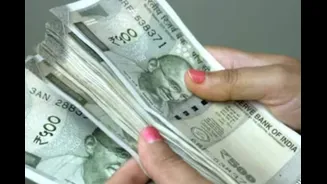

Every nation’s currency reflects its economic identity and sovereignty, from the US dollar and British pound to the Japanese yen and Chinese yuan, and together, these currencies form the backbone of global
trade. In India, the rupee plays that central role, circulating through the economy in the form of notes and coins that power everyday transactions.
While Indian currency notes are printed at four locations by two different agencies, a lesser-known question often arises: Do you know what special ink the RBI uses to print Mahatma Gandhi’s image on Indian notes?
Notes And Coins: How Indian Currency Is Made
Indian currency is divided into two forms: paper notes and metal coins. While coins are fully produced within the country, currency notes involve both domestic and international inputs. The special paper and ink used to print Indian notes are imported, making the process highly specialised.
After demonetisation in 2016, the introduction of new Rs 500 and Rs 2,000 notes attracted global attention. This has also raised a common question many people often ask: who prints Indian currency, and where is it made?
Where Are Indian Currency Notes Printed?
Currency notes in India are printed at four locations, operated by two different organisations:
- Dewas, Madhya Pradesh
- Nashik, Maharashtra
- Mysuru, Tamil Nadu
- Salboni, West Bengal
Two entities manage these presses:
- Security Printing and Minting Corporation of India Limited (SPMCIL), under the Central Government
- Bharatiya Reserve Bank Note Mudran Private Limited (BRBNMPL), a subsidiary of the RBI
This means that while the RBI oversees currency printing, it happens under government supervision.
Where Are Indian Coins Minted?
Coins are produced at four mints across the country, all managed by SPMCIL:
- Mumbai
- Hyderabad
- Kolkata
- Noida
How Much Does India Spend On Printing Currency?
The Central Government spends around Rs 4,500 crore annually on printing currency notes. The RBI disclosed these costs in its annual reports.
- 2021: Rs 4,112 crore
- 2019-20: Rs 4,378 crore
- 2016 (Demonetisation year): Rs 7,965 crore (the highest ever cost)
In July 2019, the government informed the Rajya Sabha that:
- Printing a Rs 10 note costs 0.75 paise
- Printing a Rs 2,000 note costs Rs 3.53
Why Is Printing So Expensive?
The high cost is mainly due to imported raw materials and advanced security features. Indian currency paper is made from cotton and imported from Germany, Japan, and the UK, while the specialised ink is sourced from a Swiss company.
2017-18:
- Paper: Rs 493 crore
- Ink: Rs 143 crore
- Total: Rs 636 crore
2016-17:
- Paper: Rs 366 crore
- Ink: Rs 218 crore
Special Inks Used To Prevent Counterfeiting
Indian notes use multiple advanced inks:
- Intaglio ink for Mahatma Gandhi’s portrait
- Fluorescent ink for number panels
- Optical Variable Ink (OVI) for enhanced security
The composition of these inks is changed periodically to stay ahead of counterfeiters.
How Do Notes Reach The Public?
Once printed, notes are sent to 19 RBI offices across the country, including cities such as Ahmedabad, Bengaluru, Chennai, Hyderabad, Kolkata, Mumbai, New Delhi, Patna, and Jaipur.
From these offices, currency is stored in bank-managed vaults known as ‘currency chests’, from where it finally reaches the public.
History Of Indian Currency Printing
- Before 1862: Notes were printed by a British company in the UK
- Around 1920: Printing began in India during British rule
- April 1, 1935: Reserve Bank of India was established
- January 1938: RBI issued its first Rs 5 note, followed by Rs 10, Rs 100, and Rs 1,000
- 1949: Independent India issued its first Re 1 note
- Pre-1947: Notes featured King George’s portrait
- 1969: RBI issued the first Rs 100 note with Mahatma Gandhi’s image