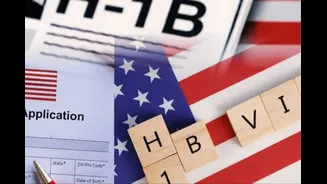








Indian professionals working in the United States on H-1B visas could face another policy shift under the Donald Trump administration, with the US government moving closer to expanding an additional visa fee
to extension applications as well.
If implemented, the proposal would significantly increase costs for employers that rely heavily on foreign skilled workers, particularly large IT companies with a substantial Indian workforce.
According to the US Department of Homeland Security’s regulatory agenda, the proposed amendment would expand the scope of the ‘9-11 Response and Biometric Entry-Exit Fee’ so that it applies not only to new H-1B and L-1 petitions and change-of-employer filings, but also to all H-1B and L-1 extension petitions filed by qualifying employers.
The proposal is currently in the final rulemaking stage, though it has not yet taken effect.
ALSO READ | Big Relief For H-1B Visa Holders? New US Immigration Bill Could Fast-Track Green Cards For Indians
The fee applies to companies with 50 or more employees in the United States, where more than half of the workforce holds H-1B or L-1 status.
At present, such employers pay an additional $4,000 for eligible H-1B petitions and $4,500 for eligible L-1 petitions only when sponsoring a worker for an initial period of stay or when the employee changes employers.
Under the proposed rule, these charges would also become payable every time the employer seeks to extend the employee’s stay.
The move is expected to have its biggest impact on technology firms and IT services companies that depend heavily on skilled foreign workers, including thousands of Indian professionals employed in the US.
According to data released by the US Citizenship and Immigration Services (USCIS) for the fiscal year ended September 30, 2025, the majority of H-1B approvals were for workers already employed in the country rather than first-time entrants.
Of the approximately 4.06 lakh H-1B petitions approved, nearly 2.91 lakh, or 71 per cent, were approved for continuing employment.
ALSO READ | Government Jobs Are More Popular Than Ever. Why Young Indians Are Choosing Security Over Risk
According to a TOI report, Indians accounted for the overwhelming majority of these renewals. Nearly 2.26 lakh Indian nationals received H-1B extensions beyond the initial maximum three-year period, accounting for roughly 77.6 per cent of all H-1B extension approvals during the fiscal year.
China ranked a distant second with 31,581 approvals, followed by the Philippines, Canada, South Korea and Mexico.
These figures indicate that any expansion of the fee would disproportionately affect Indian professionals and employers that continue to sponsor them.
The proposed change was first flagged in the regulatory agendas released by the US Departments of Homeland Security (DHS), Labor (DOL) and State (DOS) earlier this year, outlining the administration’s immigration priorities.
While the final regulation is expected in the coming weeks, the government has not yet announced an effective date.
A report by the National Foundation for American Policy (NFAP), cited by The Times of India, highlights how heavily some of the world’s largest technology companies rely on continuing H-1B employment.
During fiscal 2025, Amazon recorded the highest number of approved H-1B petitions for continuing employment at 14,532, followed by Tata Consultancy Services (TCS) with 5,293, Microsoft with 4,863, Meta Platforms with 4,740, Apple with 4,610, and Google with 4,509.
The think tank noted that these figures do not represent unique employees, as an H-1B worker may receive multiple approvals in a year because of transfers or changes in work location.
Even so, the data underscores the potential financial impact on employers if extension petitions become subject to the additional fee.
ALSO READ | US Visa Bonds Explained: Will Indians Have To Pay Up To $20,000 For Tourist Visas?