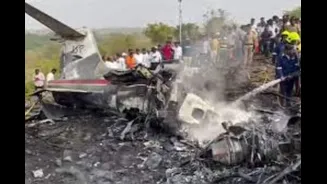

Months before the plane crash that killed Maharashtra Deputy Chief Minister Ajit Pawar on Wednesday in Baramati, a Parliamentary Standing Committee warned of serious gaps in India’s civil aviation safety
framework, specifically highlighting risks linked to the fast-growing private and charter aircraft segment. The committee report, chaired by MP Deepak Mishra and tabled in Parliament in August last year, cautioned that aviation expansion was outpacing oversight capacity and that parts of the non-scheduled sector required tighter scrutiny, Indian Express reported. The panel was set up in the wake of the deadly June 2025 crash of an Air India plane headed to London from Ahmedabad.
Warning On Private And Charter Planes
Focusing on non-scheduled operators, the committee expressed concern over maintenance standards, documentation discipline and operational control structures. It noted that some charter operators function with lean technical and safety teams, which can affect maintenance schedules and monitoring. The report stressed the need for the Directorate General of Civil Aviation (DGCA) to intensify surveillance in this segment through surprise inspections and stricter audit cycles.
It underlined that smaller operators may not have access to layered operational control centres that airlines use to support cockpit decision-making, particularly in adverse weather or during diversions. The committee called for mandatory and fully functional Safety Management Systems across all private operators, saying safety processes in the charter segment must be “on par” with those followed by scheduled carriers.
Flight planning and weather assessment practices in private operations were flagged as areas needing closer regulatory attention. The panel emphasized that risk evaluation before departure, planning and real-time operational oversight must not be diluted simply because the flight is non-scheduled.
ATC Capacity And Fatigue Risks
Air Traffic Control (ATC) infrastructure and manpower also came in for pointed scrutiny. The committee described ATC as the “backbone of aviation safety” and warned that controllers at busy airports are handling dense traffic loads without proportionate increases in staffing.
Fatigue and workload stress, especially during peak hours or poor weather, were cited as factors that can heighten the risk of human error. The panel called for accelerated recruitment of controllers, improved rostering to prevent fatigue, and faster modernisation of communication, navigation and surveillance systems. It also highlighted the need for system redundancy and smoother civil-defence airspace coordination.
Regulator Under Strain
The committee painted a broader picture of systemic stress. It said the DGCA remains “overburdened” and often works in a reactive mode due to manpower shortages and expanding responsibilities. The panel recommended strengthening technical staffing, improving training, and using data-driven risk assessment tools for predictive oversight rather than post-incident reaction. The report said that rapid fleet growth, new airports and higher aircraft movements demand parallel strengthening of safety surveillance.