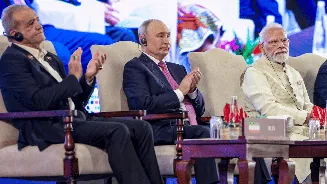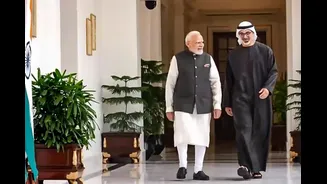






Prime Minister Narendra Modi met Abu Dhabi Crown Prince Sheikh Khaled bin Mohamed bin Zayed Al Nahyan on the sidelines of the 18th BRICS Summit in New Delhi on Saturday. The meeting underlined how far
India-UAE ties have moved beyond their traditional areas of cooperation, with discussions ranging from defence and artificial intelligence to critical minerals, energy, food security and connectivity.
The meeting came as Sheikh Khaled led the UAE delegation to the BRICS Summit on behalf of UAE President Sheikh Mohamed bin Zayed Al Nahyan. The UAE has been a full member of BRICS since the grouping’s expansion in 2024, giving the India-UAE relationship an additional multilateral dimension.
India-UAE ties have been transformed over the last few years. Now, we are raising our ambitions even higher.
Delighted to meet His Highness Sheikh Khaled bin Mohamed bin Zayed Al Nahyan.
Discussed taking our Strategic Partnership forward across defence, AI, space, critical… pic.twitter.com/omzRK4ccuP
— Narendra Modi (@narendramodi) September 12, 2026
After the meeting, PM Modi said the relationship had been “transformed over the last few years” and that India and the UAE were now looking to “raise our ambitions even higher”. In a post on X, the Prime Minister said the two sides had discussed taking their Strategic Partnership forward across defence, AI, space, critical minerals, energy, food security and connectivity.
Click here for LIVE updates on BRICS Summit 2026.
Here are five key areas that stood out from the meeting.
1. India-UAE Strategic Partnership Enters New Phase
At the heart of the meeting was the India-UAE Comprehensive Strategic Partnership, which has expanded significantly in recent years across politics, trade, energy, investment and people-to-people ties. The two leaders recalled the recent high-level exchanges between the two countries, including Sheikh Mohamed bin Zayed’s visit to India in January 2026 and Modi’s visit to the UAE in May.
The significance of this continuity was also reflected in the official readout, which described the latest engagement as reaffirming the tradition of regular leadership-level contact between India and the UAE.
For New Delhi, the UAE has increasingly become more than an important Gulf partner. It is simultaneously an investor, an energy partner, a strategic interlocutor and, since 2024, a fellow BRICS member.
2. BRICS Cooperation And UAE’s role
The BRICS setting gave the meeting an important additional dimension. PM Modi appreciated the UAE’s “active and constructive participation” in BRICS under India’s chairship. The two leaders welcomed the outcomes achieved during India’s presidency and agreed to continue working closely through the grouping on shared interests and priorities.
The expanded BRICS now brings together major emerging economies with very different geopolitical interests. The UAE’s presence gives the grouping a significant Gulf and investment dimension, while India can use its chairship to push practical cooperation in areas such as trade, energy, technology and development.
The meeting therefore served both a bilateral and a multilateral purpose: deepening India-UAE ties while ensuring that the two countries remain closely aligned within BRICS.
3. The $11.5-billion Odisha Aluminium Investment
One of the most significant economic developments discussed was the UAE’s International Holding Company’s planned $11.5-billion investment in an integrated greenfield aluminium project in Odisha.
The project is expected to become India’s largest integrated aluminium investment and could help position Odisha as a major global aluminium manufacturing hub.
For India, the investment is significant not merely because of its size but because it reflects the changing nature of Gulf capital. The India-UAE economic relationship is increasingly moving beyond conventional energy and trade towards large-scale industrial investment.
For the UAE, meanwhile, India offers a large and rapidly growing market, a deep manufacturing base and opportunities to participate in long-term infrastructure and industrial development.
4. L’Imad And The Next Wave Of UAE Investment
The leaders also discussed the potential role of L’Imad, the UAE’s newest sovereign investment fund, in taking bilateral investment ties further.
This could become another important channel for UAE capital into India, particularly as both countries look at strategic and long-term investments rather than conventional portfolio flows.
The discussion is significant because the UAE has emerged as one of India’s important sources of Gulf investment. The latest conversation suggests that both sides want to widen that investment relationship and identify new opportunities that can support their respective economic ambitions.
5. Defence, AI, Space, Energy And IMEC
The final and perhaps most strategically important part of the conversation was the broadening of cooperation into emerging and sensitive sectors. Defence, space, nuclear energy, technology and innovation were among the key areas discussed, while Modi’s post-meeting message added AI, critical minerals, food security and connectivity to the list.
The Prime Minister also specifically highlighted the potential for cooperation in strategic energy infrastructure and the India-Middle East-Europe Economic Corridor (IMEC).
This reflects the increasingly interconnected nature of India’s relationship with the UAE. Energy security is no longer limited to crude oil supplies; it now includes infrastructure, emerging technologies and resilient supply chains. Similarly, connectivity is being viewed not simply through transport links but as a strategic economic network linking India with the Gulf and Europe.
PM Modi also placed the partnership in the context of the current regional environment, saying that “at a time of uncertainty in West Asia, a strong India-UAE is a symbol of stability, prosperity and peace.”
This captures the larger significance of the meeting. As West Asia faces continuing geopolitical and security uncertainty, India is seeking deeper partnerships with countries that can serve as economic, energy and strategic anchors.