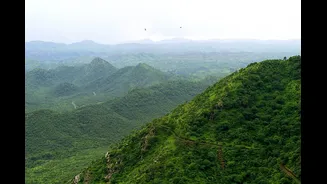

The government has pushed back against what it called “alarmist claims” about the fate of the Aravalli Hills, stating that there is no imminent ecological threat to the ancient hill range following a recent
judgment by the Supreme Court of India.
In a detailed fact-check issued by the Press Information Bureau (PIB), the government clarified that the Supreme Court has strengthened protections for the Aravallis by approving a uniform, scientific definition of the hills and ranges and imposing a freeze on new mining leases until a comprehensive, sustainable mining plan is prepared.
Supreme Court backs stricter safeguards
The clarification comes in the backdrop of the Supreme Court’s final judgment dated November 20, 2025, in which it accepted the recommendations of a high-level committee led by the Ministry of Environment, Forest and Climate Change (MoEF&CC). The committee included representatives from Delhi, Haryana, Rajasthan and Gujarat, along with technical bodies such as the Forest Survey of India and the Geological Survey of India.
The court underscored the Aravallis’ critical ecological role as a barrier against desertification, a major groundwater recharge zone, and a biodiversity habitat, warning that unregulated mining poses a “great threat to the ecology of the nation”.
What the new definition means
According to the note, the committee has introduced a clear, objective and map-verifiable definition of the Aravalli Hills and Ranges to remove ambiguity and prevent misuse.
- Aravalli Hills are defined as any landform rising 100 metres or more above local relief, including the entire hill, its supporting slopes and associated landforms up to the lowest contour encircling it.
- The Aravalli Range refers to two or more such hills located within 500 metres of each other, with the entire area between them, including valleys and smaller hillocks, brought under protection.
The government stressed that it would be incorrect to conclude that mining is allowed in all landforms below 100 metres, as slopes, foothills and intervening areas are also covered under the new framework.
Mining curbs and interim moratorium
The Supreme Court has accepted the committee’s recommendations to prohibit mining in core and inviolate areas, including protected areas, eco-sensitive zones, wetlands, tiger reserves and CAMPA plantation sites. Mining is allowed only in a narrowly defined set of cases involving critical, strategic and atomic minerals, and even then under strict safeguards.
Crucially, the court has ordered that no new mining leases be granted until a Management Plan for Sustainable Mining (MPSM) is prepared by the Indian Council of Forestry Research and Education (ICFRE) for the entire Aravalli landscape, on the lines of the Saranda forest plan in Jharkhand.
Existing mines may continue to operate only in strict compliance with environmental and forest clearances, with enhanced monitoring and enforcement against violations.
Landscape-level conservation
The report emphasised that the new approach treats the Aravallis as a continuous geological ridge from Gujarat to Delhi, rather than isolated hillocks. This landscape-level planning is aimed at preventing fragmentation, one of the biggest ecological risks facing the region.
Officials said the measures will help:
- Prevent the spread of desertification from the Thar Desert
- Protect groundwater recharge zones in foothills and valleys
- Preserve biodiversity corridors and habitats
- Safeguard Delhi-NCR’s “green lungs” that influence air quality and local climate
Government rejects alarmism
The government reiterated that ongoing afforestation, eco-sensitive zone notifications, and tighter surveillance, including the use of drones, CCTV, weighbridges, and a district-level task force, ensure that illegal mining is curbed and environmental compliance is enforced.
“Contrary to alarmist claims, there is no imminent threat to the ecology of the Aravallis,” the report said, adding that the Supreme Court-backed framework strikes a balance between ecological conservation and responsible development.
The statement concluded by reaffirming India’s commitment to protecting the Aravallis as a national natural heritage, ensuring that the ancient range continues to serve as an ecological shield for present and future generations.