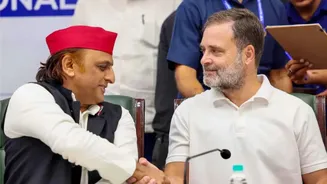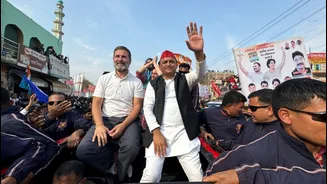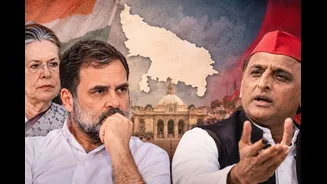







The Samajwadi Party’s decision to offer the Congress just one assembly seat across Amethi and Rae Bareli has struck a particularly sensitive nerve in the ongoing seat-sharing negotiations for Uttar Pradesh
and it’s not difficult to guess why. These are not just two parliamentary constituencies for the Congress but the heart of the Gandhi family’s political legacy in the state, and the party’s claim to them is rooted in decades of electoral history.
However, the Samajwadi Party, led by Akhilesh Yadav, has a different argument—political legacy cannot be the only basis for deciding who contests a seat. The numbers on the ground, particularly in assembly elections, tell a very different story.
That is what makes Amethi and Rae Bareli an important test of the Congress-SP alliance. The Congress sees the region as central to its revival in Uttar Pradesha but the SP sees little reason to surrender constituencies where it has built a stronger electoral presence.
ALSO READ | How Many UP Seats Does Congress ‘Deserve’ Based On Winnability? Depends On Who You Ask
So, why are these 10 assembly seats so important to both parties, what does their electoral history reveal, and why is the Gandhi family’s legacy not enough to settle the argument?
Why Amethi And Rae Bareli Matter So Much To Congress
The Congress’s emotional and political claim over the two parliamentary constituencies is difficult to dispute.
Amethi has been associated with the Gandhi family since Sanjay Gandhi won the Lok Sabha seat in 1980. After his death, Rajiv Gandhi represented it, followed by Sonia Gandhi and Rahul Gandhi. Rahul won Amethi in 2004, 2009 and 2014, before losing to the BJP’s Smriti Irani in 2019.
Rae Bareli has an even longer association with the family. Feroze Gandhi represented the constituency in the first two Lok Sabha elections, followed by Indira Gandhi, Sonia Gandhi and, most recently, Rahul Gandhi. Sonia won Rae Bareli four consecutive times before Rahul took over the seat in 2024.
ALSO READ | Not Just 2 Seats: Can Saharanpur Make Or Break Congress-SP Alliance Ahead Of UP Elections?
The 2024 Lok Sabha election also helped the Congress re-establish its presence in the region. Rahul Gandhi won Rae Bareli, while party candidate Kishori Lal Sharma defeated Smriti Irani in Amethi.
For the Congress, therefore, these constituencies are not simply seats where it wants to contest. They are central to its political identity in Uttar Pradesh. Being offered only one assembly seat across the two parliamentary constituencies is likely to be seen as a symbolic downgrade, particularly at a time when the party is trying to rebuild its organisation in the state.
But Lok Sabha victories and assembly-level strength are two different things.
What The 10 Assembly Seats Tell Us
The two parliamentary constituencies together comprise 10 assembly segments—five each in Amethi and Rae Bareli. And the 2022 assembly election results offer the clearest explanation for why the SP believes it has a stronger claim to most of them.
The Congress failed to win even one of these 10 seats in 2022. The SP won six, while the BJP took the remaining four. This is a significant shift from the region’s older political map, where the Congress had enjoyed a much stronger presence.
ALSO READ | ‘Are We Beggars?’ Imran Masood Sees Red As SP Stakes Claim To Saharanpur Amid UP Alliance Talks
In fact, 2007 was among the last major electoral highs for the Congress in this belt. Several constituencies that the party had won repeatedly, including Amethi, Bachhrawan and Sareni, had their last Congress victories in that election. The party briefly revived in 2017, winning Harchandpur and Rae Bareli, but could not hold on to that ground.
Amethi: Congress’s legacy, SP’s foothold
The five assembly constituencies under the Amethi Lok Sabha seat are Amethi, Gauriganj, Jagdishpur, Salon and Tiloi.
The SP won Amethi and Gauriganj in 2022, while the BJP secured Tiloi, Jagdishpur and Salon. The Congress did not win any of the five.
The Amethi assembly seat itself has changed hands between the SP and BJP over the past three elections. Congress’s Ameeta Singh last won it in 2007. The SP’s Gayatri Prajapati captured it in 2012, the BJP won it in 2017, and the SP returned in 2022 with Maharaji Prajapati as its candidate.
Gauriganj has also been an important constituency for the SP. Rakesh Pratap Singh won it three consecutive times from 2012, although his subsequent expulsion from the party and movement towards the BJP have complicated the local political picture.
Jagdishpur is particularly relevant to the current negotiations. The BJP won the seat in 2022, with the Congress finishing second. It is the one assembly seat from the Amethi-Rae Bareli belt included in the SP’s reported 26-seat offer to the Congress.
The Congress may see Jagdishpur as a starting point in a region it considers its own. But the SP’s larger argument is that the party’s historical association with Amethi has not translated into Assembly victories.
Rae Bareli: A Stronger Case For SP
The five assembly segments under Rae Bareli are Bachhrawan, Harchandpur, Rae Bareli, Sareni and Unchahar. Here, the SP’s claim is even stronger. It won four of the five seats in 2022, with the BJP taking Rae Bareli.
Bachhrawan, once a Congress stronghold, was won by the party repeatedly between 1967 and 1991. It returned to Congress in 2007, but the SP won it in 2012, the BJP in 2017 and the SP again in 2022.
Harchandpur and Rae Bareli offer a particularly telling picture of the Congress’s declining assembly presence. The party won both seats in 2017. However, its Harchandpur MLA Rakesh Singh and Rae Bareli MLA Aditi Singh subsequently moved to the BJP. Aditi Singh retained Rae Bareli in 2022 as a BJP candidate, while the SP won Harchandpur. Sareni has also shifted between parties. The Congress last won it in 2007, followed by victories for the SP in 2012, the BJP in 2017 and the SP again in 2022.
Unchahar, meanwhile, was represented by Manoj Kumar Pandey, who won three consecutive elections on an SP ticket before moving towards the BJP.
The result is that the SP has built a substantial assembly-level presence even in a region that remains closely identified with the Gandhi family.
Why The 2024 Lok Sabha Results Do Not Settle The Argument
The Congress has reason to point to its improved performance in the 2024 Lok Sabha election. It won six seats in Uttar Pradesh, including Amethi and Rae Bareli, while the SP emerged as the state’s biggest party with 37 seats.
But the results also came in an alliance. The Congress’s victories cannot be viewed entirely as a measure of its independent organisational strength, especially when the SP’s support and vote transfer were important to the INDIA bloc’s performance.
This is an argument that SP leaders have repeatedly made during the current negotiations. In October, SP MP Shiv Pal Singh Patel claimed that the Congress would not have won any seats in Uttar Pradesh without the alliance. He also said Rahul Gandhi had been reluctant to contest from Amethi in 2024 and was persuaded by Akhilesh Yadav to contest from Rae Bareli.
The Congress pushed back against the remarks, with its state spokesperson Anshu Awasthi saying that Patel himself had become an MP because of the INDIA bloc.
The exchange exposed a larger disagreement between the allies: how much of the 2024 electoral success should be credited to the Congress’s revival, and how much to the SP’s support?
For the Congress, the Lok Sabha results show that it has recovered some political ground and deserves a larger role in the state. For the SP, the assembly record remains the more relevant measure when deciding who can win individual constituencies.
Why The One-Seat Offer Has Become A Bigger Issue
The reported offer of just one seat in Amethi and Rae Bareli is part of a much wider disagreement over the overall seat-sharing formula.
The Congress initially sought 131 seats and later revised its demand to 120. The SP, meanwhile, offered 26 constituencies in its initial proposal. According to the SP’s stated reasoning, the 26 included the two seats the Congress won in 2022—Rampur Khas and Farenda—four where it finished second, and 20 additional constituencies.
Jagdishpur was among the four seats where the Congress finished runner-up. The offer, therefore, appears to be based on the party’s recent assembly performance rather than its historical association with the region.
The Congress, however, has a different calculation. Its demand for seats is not limited to constituencies where it won or finished second in the last assembly election. It wants to use the 2024 Lok Sabha results, its traditional pockets of influence and its plans to rebuild its organisation as part of the negotiations.
The dispute is also about local political stakes. In constituencies where the SP has sitting MLAs or leaders who have built their own bases over several elections, giving the Congress a ticket could mean overlooking established party workers and aspirants. For Akhilesh Yadav, that is not a small concession to make.
At the same time, giving the Congress only one seat in the Gandhi family’s political backyard risks sending a message that the party is being treated as a junior partner even in areas central to its identity.
What This Means For The Congress-SP Alliance
Amethi and Rae Bareli are unlikely to decide the entire seat-sharing arrangement on their own. But they capture the central contradiction in the negotiations.
The Congress wants to convert its national leadership, Gandhi family legacy and improved Lok Sabha performance into a larger Assembly presence. The SP wants seat allocation to reflect its stronger organisation and electoral performance in the state.
Akhilesh Yadav has publicly said that winnability should guide the negotiations and that the two parties should work towards consensus candidates capable of defeating the BJP. But the question is who gets to define winnability: the party’s past performance, its current organisational strength, the 2024 Lok Sabha vote, or its potential to expand.
That is where the two sides are struggling to find common ground.