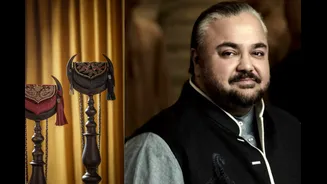







In a career that has long been defined by opulence, narrative, and an almost cinematic approach to couture, JJ Valaya has never been one to follow the predictable arc of luxury. His work has consistently
drawn from the grandeur of royal India, the intricacies of Byzantine artistry, and a deeply personal vocabulary of heritage. And yet, with the launch of JJ Valaya Couture Accessories, the designer enters a new chapter, one that feels less like expansion and more like distillation.
Handbags, in the global luxury lexicon, are rarely just accessories. They are entry points, cultural markers, and often the most intimate way a brand is experienced. For Valaya, this shift is both strategic and instinctive.
“It felt like a natural evolution,” he reflects. “Over the years, we have built a very distinct design vocabulary through couture. Accessories allow that language to move into everyday life.”
At the heart of this debut lies a piece that is as personal as it is symbolic: The Raj & The Jagjit bags. Named after his parents, the design is conceived as a dual form, the larger Jagjit bag encasing the smaller Raj, a gesture that speaks quietly of protection, inheritance, and enduring love. It is not merely a design flourish, but an emotional architecture.
“My parents have been the most defining influence in my life,” Valaya says. “Naming the bags after them was not a marketing idea, it was instinctive.”
In an industry increasingly driven by spectacle, this return to intimacy feels both timely and quietly radical. Luxury, as Valaya suggests, is no longer just about acquisition, but about resonance. A piece that carries a story, whether personal or cultural naturally acquires a different kind of permanence.
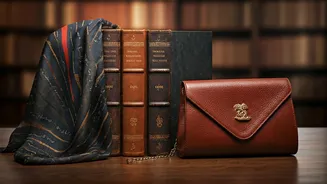
This sensibility extends across the collection’s 14 silhouettes, each navigating the delicate intersection of ornament and utility. There is the Mini Flap Bag, compact yet assertive, designed for both festive dressing and contemporary bridal wardrobes. The Batua Belt Bag reinterprets a traditional Indian form with a modern pragmatism, its leather and crystal tassels adding a subtle playfulness. And then, the Oversized Clutch, perhaps the most overtly decadent, draws from Persian and Mughal carpet traditions, its velvet surface enriched with embroidery and beadwork, anchored by a sculptural brass charm set with semi-precious stones.
View this post on Instagram
Yet, what defines the collection is not its references, but its restraint.
“The balance comes from editing, not dilution,” Valaya explains. “The inspiration may come from royal India or historical narratives, but it is always distilled before it reaches the product.”
This philosophy of refinement over excess signals a broader shift in Indian luxury. For decades, the challenge has not been a lack of cultural depth, but an over-articulation of it. Valaya’s approach suggests a maturation: heritage not as surface decoration, but as a quiet undercurrent expressed through proportion, texture, and detail.
It is also a response to the demands of the modern luxury consumer, for whom functionality is non-negotiable. “In accessories, proportion, weight, compartments, ease of use, they all have to work seamlessly,” he notes. The result is a collection that feels considered rather than ornamental, where craftsmanship is not sacrificed at the altar of spectacle.
This balance becomes particularly significant as Indian designers seek to position themselves within the global luxury ecosystem, still largely dominated by European houses. For Valaya, the opportunity lies not in imitation, but in precision.
“The advantage we have is authenticity,” he says. “What is required now is editing, infrastructure, and a clear, contemporary point of view.”
If authenticity is India’s strength, then discipline, he suggests, must be its next evolution.
From a business standpoint, the move into handbags is equally telling. Unlike couture, which exists within the rarified world of occasion and patronage, accessories offer continuity, daily visibility, repeat engagement, and the possibility of scale.
“Handbags have the potential to become our most consistent and scalable category,” Valaya acknowledges. “They allow us to build a stronger, more recurring relationship with the consumer.”
And yet, even within this commercial logic, the designer resists the churn that defines much of contemporary fashion. His approach to sustainability is rooted not in trend-driven rhetoric, but in longevity.
“For me, sustainability begins with endurance,” he says. “We create pieces that are meant to be used and cherished for years, not replaced seasonally.”
It is a philosophy that feels increasingly relevant in a moment where luxury is being redefined, not by speed, but by permanence; not by volume, but by value.
With JJ Valaya Couture Accessories, the designer does not simply enter a new category. He reframes it. The handbag, in his world, is no longer just an object of desire, but a vessel of memory, something carried not only in hand, but across time.