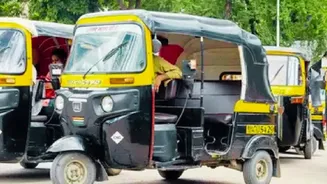






Maharashtra Deputy Chief Minister Eknath Shinde on Friday launched the Dharmaveer Anand Dighe Saheb Passenger Transport Driver-Owner Welfare Board, announcing a series of social security measures for auto-rickshaw
and taxi driver-owners across the state, as reported by Mid-day.
Speaking at an event in Thane, Shinde said the initiative aimed to recognise the contributions of transport workers and provide greater financial and social security to people who largely depend on daily earnings.
One of the key announcements is a Retirement Honour Scheme for driver-owners who have completed 65 years of age. Eligible beneficiaries will receive an honourarium of Rs 10,000. Eknath Shinde said the money had already been deposited into the bank accounts of around 735 eligible beneficiaries who had submitted their bank details. The remaining beneficiaries will receive the amount in phases.
Unlike employees in organised sectors, auto-rickshaw and taxi driver-owners generally do not have a fixed retirement age or assured financial support after they stop working. Shinde said the new scheme was intended to recognise their contribution after years behind the wheel.
Insurance And Health Support For Drivers
The welfare package also includes life and disability insurance for drivers while on duty. Driver-owners will receive health assistance as well as financial support for injuries sustained while working. The measures aim to provide a safety net for workers whose income can be severely affected if they are injured or unable to drive.
Shinde also highlighted the wider role played by transport workers in society, saying auto-rickshaw and taxi drivers often help accident victims and assist elderly passengers, women and children.
Scholarships For Children Of Auto And Taxi Drivers
The welfare measures extend to the families of driver-owners, with scholarships announced for their children. Students who secure at least 75% in Class 10 will receive Rs 5,000, while those scoring at least 75% in Class 12 will receive Rs 7,000.
Financial assistance will also be available for degree-level education, with support linked to academic performance.
Eknath Shinde said the package was intended to cover not just the working years of driver-owners but also their healthcare, children’s education and financial security in later life.
Why Is The Board Named After Anand Dighe?
The welfare board has been named after late Shiv Sena leader Anand Dighe, a powerful political figure in Thane and Shinde’s political mentor. Eknath Shinde has frequently spoken about Dighe’s influence on his political career. Anand Dighe was the Shiv Sena’s prominent leader in Thane and played an important role in building the party’s organisation in the region. Shinde entered electoral politics in Thane under Dighe’s mentorship.
Anand Dighe’s life and relationship with Eknath Shinde have also been portrayed on screen in the Marathi film Dharmaveer: Mukkam Post Thane, with Prasad Oak playing Dighe and Kshitish Date portraying Shinde. A sequel, Dharmaveer-2, was released in 2024 and continued the story of Dighe’s political journey and his association with Shinde.
The naming of the new welfare board therefore carries particular significance in Thane, where Dighe’s political legacy remains closely associated with Shinde’s rise.
Shinde’s Auto-Rickshaw Past Comes Into Focus Again
The welfare package also comes at a time when the role and rights of auto-rickshaw and taxi drivers have become a politically sensitive issue in Maharashtra, particularly amid the ongoing debate over Marathi language requirements and app-based transport services.
Eknath Shinde’s own early career is often brought up in political debates because he once worked as an autorickshaw driver before entering politics. His family had moved from Satara to Thane, and after taking up various jobs, Shinde drove an autorickshaw to support himself before becoming associated with the Shiv Sena in the 1980s.
Opponents have repeatedly referred to his background while questioning government decisions affecting transport workers. The issue resurfaced recently amid the debate over app-based bike taxis.
Transport Minister Pratap Sarnaik defended the government’s approach, saying it did not need anyone’s certificate to prove that it cared about auto drivers. “An auto driver can become a chief minister, an auto driver can become transport minister,” Sarnaik said, arguing that the experience of people who have worked in the profession gives them the sensitivity required when making decisions affecting drivers.
Eknath Shinde Recalls Drivers’ Role During COVID-19
At Friday’s event, Shinde also recalled the role played by auto-rickshaw and taxi drivers during the COVID-19 pandemic. He said many transport workers risked their lives to take patients to hospitals at a time when fear and uncertainty were widespread.
He also highlighted the contribution of women drivers through the Pink Rickshaw initiative in Thane, pointing to the growing participation of women in the transport sector.
Government Pushes Marathi Learning Among Drivers
The event also comes against the backdrop of the ongoing Marathi language debate involving auto-rickshaw and taxi drivers in Maharashtra. Eknath Shinde called for a renewed campaign encouraging drivers to learn Marathi. He said around 1.65 lakh people had previously learnt the language through 180 centres across Maharashtra.
The issue has recently become a point of political friction within the ruling Mahayuti alliance, with the government’s approach to Marathi language requirements for drivers drawing debate.
Eknath Shinde has argued that Marathi should help drivers communicate beyond simply asking passengers for their destination, particularly when dealing with elderly passengers and others who may need assistance.
From Retirement Aid To Education: What Drivers’ Families Will Get
The new welfare board therefore brings together benefits across several stages of a driver-owner’s life. A 65-year-old eligible driver can receive the Rs 10,000 retirement honourarium, while working drivers will have access to life and disability insurance and health assistance.
Their children can receive educational support, including Rs 5,000 for students scoring at least 75% in Class 10 and Rs 7,000 for those achieving the same benchmark in Class 12, with further assistance available for degree-level education.
Eknath Shinde said the government was committed to fulfilling its promises to the transport community and presented the retirement honourarium as one example of that commitment.