






US President Donald Trump on Tuesday announced a new trade order targeting countries that continue to do business with Iran. Under the directive, any nation trading with Tehran will face a 25 per cent
tariff on all business conducted with the United States. The move has raised concerns for several of Iran’s key trading partners, including India.
The announcement comes shortly after US Ambassador-designate Sergio Gor described India as the “most essential partner” of the United States, highlighting a sharp contrast between diplomatic messaging and emerging trade risks.
India already faces steep US tariffs in the absence of a bilateral trade deal. Indian goods are currently subjected to a 50 per cent tariff — comprising a 25 per cent reciprocal duty and an additional 25 per cent punitive levy imposed by Trump over India’s continued purchases of Russian oil. If the new Iran-linked tariff is added, total US tariffs on Indian imports could rise to as high as 75 per cent.
Given that India is among Iran’s top five trading partners, the fresh US order significantly heightens trade uncertainty for New Delhi.
What is happening in Iran?
Iran is witnessing one of its most turbulent periods in recent years, with widespread protests erupting against the Ayatollah Ali Khamenei-led government amid escalating tensions with the United States. Demonstrations have spread across several cities, pushing the country into deep political and economic uncertainty.
The situation has deteriorated to such an extent that the Iranian government has shut down internet and mobile services nationwide in an attempt to control the unrest.
While the turmoil is domestic in nature, its impact extends beyond Iran’s borders. For India, instability in Iran directly affects strategic, economic and geopolitical interests.
New Delhi maintains long-standing trade and strategic ties with Tehran, including cooperation on energy imports and the development of the strategically important Chabahar Port. The port serves as India’s gateway to Afghanistan and Central Asia, bypassing Pakistan, and is also a key node in the International North-South Transport Corridor (INSTC).
Any prolonged disruption in Iran could slow operations at Chabahar and affect trade movement through the INSTC, dealing a blow to India’s regional connectivity ambitions.
Trade between India and Iran
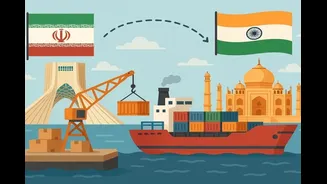
According to Department of Commerce data, bilateral trade between India and Iran stood at approximately USD 1.68 billion in FY2024-25 (April 2024 to March 2025). Of this, India exported goods worth USD 1.24 billion, while imports were significantly lower at USD 440 million.
Goods traded between the two nations
India has emerged as one of Iran’s five largest trading partners. Major Indian exports to Iran include basmati rice, tea, sugar, pharmaceuticals, synthetic fibres, electrical machinery and artificial jewellery.
In return, India imports dried fruits, inorganic and organic chemicals, and glassware from Iran.
With Iran facing escalating unrest and the US tightening its trade stance, India now finds itself navigating a complex mix of geopolitical risk, strategic dependency and rising tariff pressure — a combination that could reshape its trade outlook in the months ahead.