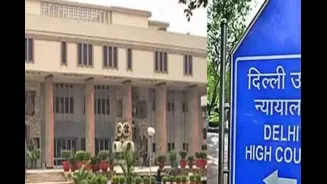









The Delhi High Court on Wednesday said that the one year separation period required as a pre-requisite for presenting the first motion for divorce by mutual consent is not mandatory and can be waived in by courts
in appropriate cases.
A bench comprising Justice Navin Chawla, Justice Anup Jairam Bhambhani and Justice Renu Bhatnagar held that the condition prescribed under Section 13B(1) of the Hindu Marriage Act, 1955 is not mandatory and the separation period can be waived by applying the proviso to section 14(1) of the enactment, LiveLaw reported.
Citing several Supreme Court judgments and their subsequent interpretations, the bench said Section 13B(1), which begins with the words “subject to the provisions of this Act”, must be read harmoniously under the conditions of Section 14(1) of the HMA.
“Where the court is satisfied that the 01-year period under section 13B(1) and the 06-month period under section 13B(2) of the HMA deserve to be waived, the court is not legally mandated to defer the date from which the divorce decree would take effect, and such decree may be made effective forthwith,” the bench observed.
However, the High Court ruled that such waiver is not to be granted merely for the asking but only upon the court being satisfied that circumstances of “exceptional hardship to the petitioner” and “exceptional depravity on the part of the respondent” exist.
Section 14(1) of the Hindu Marriage Act allows courts to waive statutory waiting periods in rare cases involving “exceptional hardship” or “exceptional depravity”. The bench said that the waiver of the one year period and the six month period are to be considered independently of each other, the news outlet reported.
The bench rendered these findings while answering a reference arising from conflicting interpretations of whether parties must complete one year of separation before approaching the court for mutual consent divorce.
The bench held that the view taken earlier by the various Single Benches holding that section 13B of the HMA is a complete code in itself and that the proviso to section 14(1) of the HMA does not apply to petitions filed under section 13B is not the correct view.
“In all other cases, the mere consensual assertion of the parties is sufficient to fulfil the requirements of section 13B(1) of the HMA and cannot be second- guessed. In a sense therefore, verification of the 01-year separation period in section 13B(1) is all but illusive,” the High Court said as reported by the news outlet.
The bench emphasised that the core requirement of Section 13B is the free and informed consent of both parties, not rigid adherence to timelines. Forcing unwilling spouses to remain legally bound in a broken marriage could amount to an unjustified intrusion into personal liberty and dignity under Article 21 of the Constitution, the Court added.