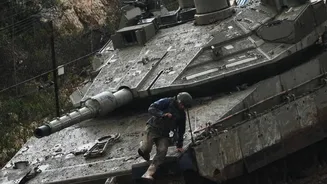





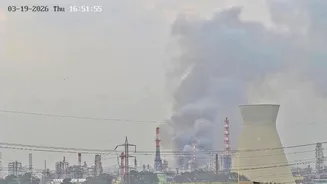

The focus of the ongoing US-Israel war against Iran is increasingly shifting toward control of the Strait of Hormuz, a strategic maritime chokepoint through which roughly one-fifth of the world’s oil and
gas supplies transit.
According to The Washington Post, US and Israeli security officials now view the reopening of the strait as the most achievable strategic objective, as earlier ambitions such as regime change in Tehran or permanently eliminating Iran’s nuclear programme appear increasingly unlikely.
The Washington Post reported that breaking Iran’s grip on the narrow waterway could provide US President Donald Trump with a pathway to wind down the war while claiming a strategic victory, stabilising global energy markets and weakening Tehran’s ability to deter future strikes.
Iran’s actions have brought tanker traffic through the strait close to a halt, reducing daily vessel movement from roughly 130 oil tankers in peacetime to only a limited number allowed passage under Iranian conditions.
Officials cited by the newspaper said the ability to reopen Hormuz could deprive Iran of a major source of leverage and reshape the broader trajectory of the conflict.
TRUMP’S ULTIMATUM SIGNALS NEW PHASE OF CONFLICT
The shift in focus has been underscored by an escalation in rhetoric from Washington, including a direct ultimatum issued by Trump demanding that Iran allow unrestricted navigation through the strait.
“If Iran doesn’t fully open, without threat, the Strait of Hormuz, within 48 hours… the United States of America will hit and obliterate their various power plants,” Trump wrote on Truth Social.
The Associated Press reported that Trump has cycled through multiple strategies in recent days, ranging from calls for international naval cooperation to temporarily lifting sanctions on Iranian oil, before escalating to threats targeting civilian energy infrastructure.
Critics have raised concerns about the implications of such threats.
Democratic Senator Ed Markey said Trump “has no plan to reopen the Strait of Hormuz,” warning that striking power plants could amount to a war crime.
Senator Chris Murphy said the President appeared to be “panicking” as oil prices climbed and the conflict entered its fourth week, AP reported.
Legal experts cited by AP said international law sets a high bar for attacks on civilian infrastructure, requiring proof that military advantages outweigh potential harm to civilians.
ALSO READ | Pakistan Hikes High-Octane Fuel Price From PKR 100 To PKR 300 As Crisis Worsens Amid Hormuz Closure
US MILITARY BUILDUP POINTS TO POSSIBLE OPERATION
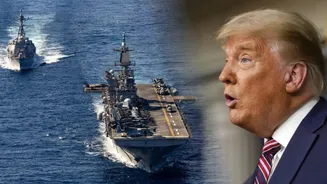
The Washington Post also reported that the United States has begun deploying additional forces to the Middle East, including approximately 4,500 sailors and Marines supported by helicopters, F-35 fighter jets and armoured landing vehicles.
The Pentagon has also accelerated the deployment of the 11th Marine Expeditionary Unit, indicating preparations for potential operations related to securing maritime routes and key energy infrastructure.
“Those Marines aren’t coming for decoration,” an Israeli official told The Washington Post, speaking on condition of anonymity.
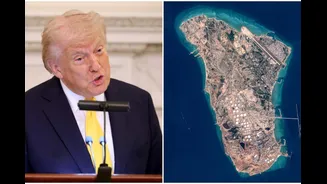
Officials were quoted as saying that a possible objective could include securing Kharg Island, Iran’s main oil export hub, which could significantly impact Tehran’s revenue stream and weaken its strategic position.
Iran has warned it would retaliate by targeting US-linked infrastructure across the Gulf region, including energy, water and information technology assets.
GLOBAL ENERGY MARKETS UNDER PRESSURE
The escalating confrontation around Hormuz has meanwhile rattled global markets, with analysts warning of sustained volatility if disruptions continue.
According to Reuters, Brent crude traded near $112 per barrel while US West Texas Intermediate hovered close to $99 amid uncertainty over whether the strait will reopen.
Analysts cited by Reuters said momentum favours further price increases, with the possibility of crude approaching $120 per barrel if tensions intensify.
International Energy Agency chief Fatih Birol warned the global economy faces a “major, major threat” from the crisis, AFP reported, comparing the situation to the oil shocks of the 1970s.
Birol said the crisis represented “two oil crises and one gas crash put all together,” emphasising that “no country will be immune to the effects of this crisis if it continues to go in this direction,” according to AFP.
Analysts estimate the conflict has disrupted between 7 million and 10 million barrels per day of oil production across the region.
RISKS AND COMPLEXITIES OF SECURING THE STRAIT
Despite US strikes on Iranian missile launch sites, suspected mine-laying vessels and fast attack craft, commercial shipping has yet to recover significantly.
The Washington Post reported that reluctance by the United States to deploy naval vessels directly into the strait underscores the complexity of the mission.
Threats include underwater mines, drone attacks and missiles launched from concealed coastal positions.
A former Israeli security official told the newspaper that the slow progress toward reopening the strait indicates the challenge is “more complicated than expected.”
Experts noted that maintaining secure passage would likely require sustained escort operations and intelligence monitoring, potentially tying up military resources for an extended period.
Past attacks on commercial vessels by Iran-backed Houthi forces in the region have demonstrated the difficulty of protecting maritime shipping lanes even when threats come from proxy groups with fewer capabilities.
REGIONAL ACTORS SIGNAL GROWING CONCERN
Gulf countries have begun signalling concern over the continued disruption of shipping through the waterway.
AFP reported that Saudi Foreign Minister Prince Faisal bin Farhan warned that Saudi Arabia’s “patience is not unlimited,” while the United Arab Emirates joined a coalition expressing “readiness to contribute to appropriate efforts to ensure safe passage through the Strait.”
Iran has warned that attacks on its power plants could trigger retaliation against infrastructure across the Gulf.
Iranian officials have also suggested that maritime traffic through the strait may not return to normal levels, with lawmakers considering tolls on vessels passing through the waterway, AFP reported.
CONTROL OF HORMUZ MAY SHAPE WAR’S OUTCOME
Israeli officials told The Washington Post that control of the strait would limit Iran’s ability to threaten global energy supplies or retaliate against future military operations.
Former Israeli military intelligence chief Amos Yadlin said Iran’s ability to block Hormuz provides a powerful deterrent.
“But if Iran can block Hormuz, they have a deterrence tool,” Yadlin said.
As the war continues into its fourth week, the struggle over the Strait of Hormuz has become central to both the military and economic dimensions of the conflict, with global markets, regional security and geopolitical alliances increasingly shaped by developments around the critical waterway.
ALSO READ | ‘Betrayal, Bitter Experience’: Iranian Foreign Minister Says Negotiations With US ‘Over Forever’