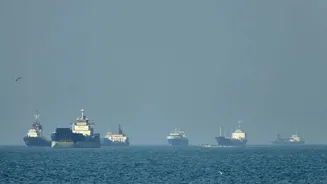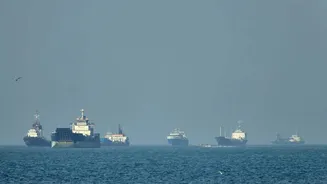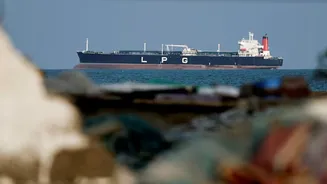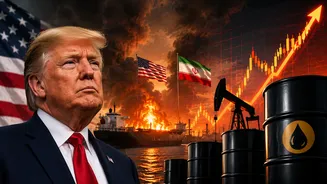




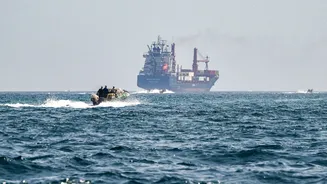

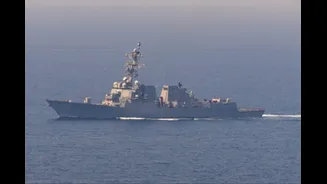
Iran has created a new government body, the Persian Gulf Strait Authority (PGSA), to regulate ship movements through the Strait of Hormuz and collect tolls from vessels using the strategic waterway that
handles nearly 20 per cent of global oil trade.
Tehran has presented the PGSA as a regulatory authority overseeing maritime transit through the strait. The agency has introduced an email-based application process under which ships must submit details including ownership records, insurance information, crew manifests and intended transit routes before receiving approval to pass through the corridor.
Iran’s state broadcaster IRIB said vessels would have to use the new transit “mechanism” to “obtain authorisation for passage” through Hormuz.
The shipping industry has described the move as the formalisation of a “Tehran toll booth”, under which Iran would vet vessels before permitting transit. According to shipping publication Lloyd’s List, some ships have reportedly paid up to $2 million for transit approval, with payments allegedly made in Chinese yuan. Iran has not officially announced any tariff structure or payment process.
The announcement has raised concerns among shipping companies and insurers. Speaking during a webinar, Lloyd’s List editor-in-chief Richard Meade said Iran had positioned the PGSA “as the only valid authority to grant permission to ships transiting the straits”.
“We asked them for details and they sent us an application form so that we could get our ship approved,” Meade said. “We would be required to submit detailed records of our ownership, insurance, crew details and intended transit route.”
Although Iran signed the United Nations Convention on the Law of the Sea, which came into force in 1994 and guarantees transit rights through international straits, it has never ratified the agreement.
Meade said concerns remained over “what kind of freedom of navigation is going to be left in place” under the proposed reopening framework.
Arsenio Longo, founder of maritime intelligence firm HUAX, said the significance of the move lay in the “institutionalisation” of a new traffic-control regime in Hormuz.
In recent weeks, some vessels travelling through the strait had already begun embedding ownership, cargo and routing details into their destination fields to signal compliance. Longo said the PGSA would now formalise those wartime practices.
Describing the requested information as “geopolitical vetting”, Longo said: “Iran is not only saying ‘pay us’. It is trying to create a traffic regime. That turns Hormuz from a passage into a checkpoint.”
Lloyd’s List Asia-Pacific editor Cichen Shen said there was a major difference between how the shipping industry and Tehran viewed the reopening of Hormuz.
“We think it should be a return to the pre-war conditions when it comes to opening the strait – free transit,” Shen said. “But Tehran obviously begs to differ.”
“The Iranian authorities have said on various occasions that the strait is open, but under ‘my watch and under my control’ – and it’s a paid transit now.”
The formal transit approval process has also raised concerns about sanctions exposure. Guidance issued in April by the US Treasury’s Office of Foreign Assets Control warned that payments made to Iran in exchange for safe passage could expose non-US firms to secondary sanctions.
‘Control Area’
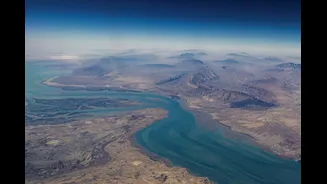
Separately, Iran announced on Monday the creation of a “control area” extending from the Gulf of Oman into the Gulf. The proposed zones reportedly include commercially important waters, with one boundary stretching from Mount Mobarak in Iran to Fujairah in the UAE, while another extends from western Qeshm Island toward Umm Al Quwain.
The developments come as Washington and Tehran continue negotiations this week over a ceasefire and a framework for reopening Hormuz.Longo said the proposed maritime zones should be viewed as diplomatic “bargaining with operational consequences”.
“The zones as described appear to reach into waters associated with UAE and Omani sovereignty,” he said.
“But Iran does not need recognition to create pressure. Iran needs compliance. If vessels delay, reroute, seek approval, or insurers price the area differently, then the zone has already started to shape behaviour.”