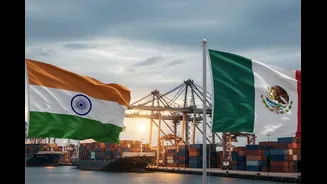

Mexico has approved sweeping new tariffs of up to 50% on imports from India, China and several other Asian economies, a move expected to affect India–Mexico trade from 1 January 2026.
The measures, passed
by both houses of Mexico’s Congress, target more than 1,400 products, including automobiles, auto parts, textiles, clothing, plastics, steel, appliances and electronics. India, which does not have a free trade agreement with Mexico, is among the countries directly impacted.
Mexican President Claudia Sheinbaum’s government says the tariff package is intended to boost domestic manufacturing and address growing trade imbalances, particularly with China. Lawmakers also framed the move as part of efforts to strengthen local supply chains and reduce reliance on low-cost imports.
Mexico’s Economy Ministry had first floated the proposal in September, but it faced resistance from China and domestic business groups before eventually clearing Congress with 281 votes in favour.
However, analysts say the reform is equally aimed at appeasing the United States as Washington presses Mexico to curb the influx of Asian goods that may be using the country as an export hub to bypass US tariffs.
The push comes ahead of the next review of the US–Mexico–Canada Agreement (USMCA), with US officials warning that China, Vietnam, Indonesia, and India, are expanding their manufacturing footprint in Mexico. The tariffs are also expected to generate an estimated $3.76 billion in additional revenue as Mexico attempts to reduce its fiscal deficit.
China has sharply criticised the decision, saying the duties will “substantially harm the interests of trading partners, including China,” and urged Mexico to “correct” its policy. Beijing has also launched an investigation into Mexico’s trade actions. Despite China’s objections, Chinese automakers such as BYD and MG have been expanding operations in Mexico, contributing to Washington’s concerns that Beijing is using Mexico as a workaround to enter the US market.