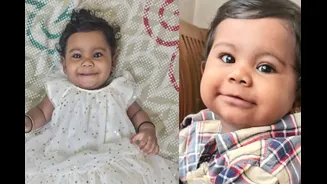








In a hospital corridor heavy with silence and grief, a 10-month-old baby became a symbol of courage that Kerala will remember for years. Alin Sherin Abraham, a baby from Mallappally in Pathanamthitta district,
tragically passed away during treatment after a road accident earlier this month. Following her unfortunate demise, her parents decided to turn personal tragedy into hope as they consented to donate their daughter’s organs.
On February 5, around 2.30 pm, the baby was travelling with her mother and grandparents from Kottayam to Thiruvalla via MC Road when a car coming from the opposite direction rammed into their vehicle near a junction. The impact left the child critically injured, and the family was also seriously hurt.
The retrieval of Alin’s organ for donation took place at Amrita Hospital. Her liver, two kidneys, heart valve and two eyeballs were recovered. The liver is set to save a six-month-old baby undergoing treatment at KIMS Hospital, making him the youngest child in the state to receive a liver through posthumous donation. The kidneys will help a child at Thiruvananthapuram Medical College’s SAT Hospital. The heart valve will be transplanted at Sree Chitra Tirunal Institute for Medical Sciences and Technology, while the corneas will remain at Amrita Hospital.
What Is Organ Donation And When Does It Actually Happen
It is the process of giving an organ, or a part of an organ, to someone who needs a transplant to survive. A transplant is a surgery in which doctors remove a healthy organ from a donor and place it into the body of a patient who is struggling to survive.
Organ donation can take place either while a person is alive or after death. When someone donates while they are alive, it is called a living donation. The human body is capable of functioning normally even after donating certain organs. For example, a person can donate one kidney as they are born with two and can live a healthy life with just one. Similarly, a part of the liver can be donated.
Deceased donation happens after a person is declared brain dead. Even though machines may temporarily keep the heart beating and oxygen circulating, the person has legally and medically passed away. It is only after the confirmation of brain death and with the consent of the family that organs can be retrieved for transplantation.
In simple terms, living donation is a voluntary act by a healthy person, while deceased donation is a final gift made possible after death.
How To Register As An Organ Donor
Pledge online through your state’s organ donation registry.
Register through authorised hospitals.
Sign up via organisations working under the National Organ and Tissue Transplant Organisation (NOTTO).
Carry an organ donor card.
Even after registration, family consent is mandatory at the time of death. That is why experts say the most important step is having an open conversation with your loved ones.
Can Children Be Organ Donors
Yes, children can be organ donors. There is no fixed minimum age for organ donation. The key factor is whether the organs are medically suitable for transplantation. In the case of children under 18, the decision is in the hands of the parents or legal guardians, who must provide consent.
Infant and pediatric organ donation is uncommon, but it can make an extraordinary difference because young patients waiting for transplants often require organs that match their small body size. Simply put, children, including infants, can become organ donors after death, provided their organs are medically fit, and their guardians agree to the donation.
Myths Vs Facts
Myth: If you agree to donate your organs, your family will have to pay for the procedure.
Reality: Organ and tissue donation does not cost the donor’s family anything. The hospital and transplant system handle the expenses. The family is only responsible for regular funeral or cremation costs.
Myth: Organ donation will disfigure the body and affect last rites.
Reality: Organ removal is done carefully and respectfully by a highly trained surgical team. It does not change the person’s appearance in a way that would interfere with viewing, burial or cremation.
Myth: Doctors do not try hard to save someone who is a registered organ donor.
Reality: When someone is brought to a hospital sick or injured, the only focus of the medical team is to save that person’s life. Organ donation is not even discussed unless every life-saving effort has failed and death is declared.
Myth: Brain death is just like a coma.
Reality: Brain death is legally and medically recognised as death. It means there is a complete and irreversible loss of all brain function. On the other hand, a person in a coma still has some level of brain activity and may recover, depending on the condition.