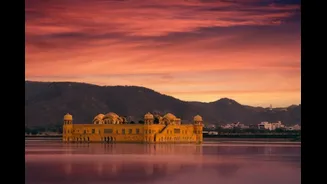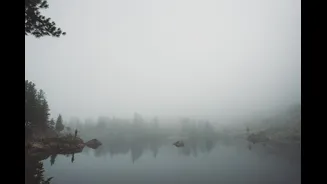

At 6:45 AM, the lake looked peaceful. The road did not. One minute you could see the curve of the service lane, the next minute it felt like someone had pulled a white curtain across the ORR. Headlights
turned into soft blobs. Auto tail lamps became tiny red commas. A jogger near the water slowed down, zipped up, and muttered, “This fog is thicker near the lake, no?”
If you commute in Bengaluru, you have probably noticed it too. Fog is not evenly spread. It loves certain pockets. Lake edges. Low lying layouts. And long, fast stretches like the Outer Ring Road where you are moving just fast enough to realise, oh wow, visibility just dropped.
What Fog Really Is, In Simple Terms
“Fog is basically a cloud that decided to sit on the ground”, says Dr Krishna Mukund, weather expert from Bengaluru. “It forms when air near the surface cools enough for water vapour to condense into tiny droplets. The easiest time for this to happen is early morning because the ground cools overnight, especially under clear skies and calm winds.”
If the air becomes saturated, meaning it cannot hold more moisture at that temperature, water vapour turns into droplets. Those droplets scatter light, and suddenly your world looks like it has been blur filtered, he further explains.
Why Lakes Make Fog Thicker
Lakes act like moisture banks. Even in winter, lake water and wet soil around it release moisture into the air through evaporation. That extra moisture increases humidity in the air nearby, making it easier to reach saturation when temperatures drop before sunrise.
There is also a second effect. The area around lakes often cools faster and stays cooler. Cooler air is denser, so it settles lower. That creates a neat little trap for moisture right where you walk, drive, and wait for the bus.
A lake side walker in HSR put it simply in an illustrative quote: “Near the water, it feels like the air has weight. My glasses fog up before my shoes do.”
The ORR Factor, Concrete, Heat, And Micro Weather
ORR stretches can intensify fog in a very Bengaluru way. Not because ORR creates fog from nothing, but because it shapes how air moves and cools.
Wide roads, flyovers, service lanes, and tall buildings create corridors that slow wind and churn air in uneven ways. When winds are light, pockets of cooler, moist air can sit longer, especially near underpasses, bus bays, and low spots where cold air pools.
Then there is the urban heat island effect. The city stays warmer than the outskirts at night because concrete and asphalt store heat and release it slowly. That sounds like it should prevent fog, but it can also create sharp temperature contrasts between a lake edge and a nearby built up road corridor. Where moist air meets a sudden cool surface zone, condensation becomes more likely.
A traffic constable’s illustrative quote captures the commuter reality: “The fog suddenly thickens near certain curves and under flyovers. Drivers do not expect it, and that is when near misses happen.”
Why It Feels Worse On Some Mornings
Fog gets thicker when these conditions stack up:
- Clear skies at night, which lets the ground lose heat faster
- Calm winds, so the moist air is not mixed away
- High humidity from lakes, wet soil, or even overnight drizzle the day before
- Cooler minimum temperatures, which push air to saturation sooner
If you notice fog that is patchy, thick near lakes, and thinner 2 km away, that is normal. Fog is local. It is basically hyperlocal weather doing its own thing.
What You Can Do If You Commute Through These Pockets
Use low beam, not high beam. High beam reflects back off fog droplets and makes visibility worse. Increase following distance. Avoid sudden lane changes near lake adjacent turns and flyover shadows. If visibility drops sharply, slow down gently and follow lane markings. And if you wear a helmet visor, keep it clean, because fog plus dust equals instant blur.
By 7:20 AM, the fog lifted like it had a schedule. The lake looked normal again. The ORR woke up fully, loud and impatient. That jogger near the water walked on, the same way Bengaluru does after every weather surprise.
The fog was never random. It was moisture from the lake, cooling air, and a city built in corridors and pockets. The kind of science that is invisible, until you drive straight into it.