




For more than a century, radio waves from Earth have been travelling through space. This was never part of a grand scientific mission. It began simply when humans discovered a way to communicate across
oceans. However, these signals did not stop at Earth’s edge. They continued outward at the speed of light, spreading deep into space.
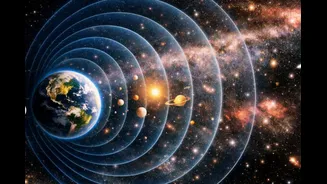
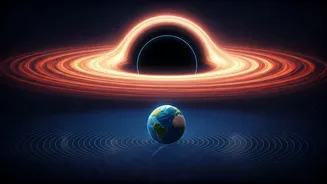
Scientists refer to this expanding region as the ‘Earth radio bubble’. It cannot be seen or touched—it merely represents how far our earliest broadcasts have travelled. As time passes, the bubble grows larger, but the signals within it become weaker and fainter. This has led scientists to ask an intriguing question: how far has humanity’s voice travelled, and could anyone else be listening?
How Humans First Sent Their Voice Into Space
The story begins in 1906, when inventor Reginald Aubrey Fessenden carried out a historic experiment. On December 24, he conducted the world’s first public radio broadcast. Unlike earlier transmissions, it did not rely on Morse code. Instead, listeners heard music and spoken words for the first time.
Fessenden played the violin and read passages from the Bible. Ships at sea received the broadcast, unaware that they were witnessing a moment that would change human communication forever. While the sound ended on Earth, the radio waves themselves did not stop. They continued moving outward into space.
The Birth Of Earth’s Radio Bubble
After that first broadcast, countless radio signals followed. Together, they formed what scientists now call the Earth radio bubble. Radio waves are a type of electromagnetic radiation with the longest wavelengths and lowest frequencies. Crucially, they do not require a medium to travel.
Because space is a vacuum, these waves can move freely through it. This is why Earth’s signals have continued their journey for decades, long after the original broadcasts ended.
How Big Is The Earth Radio Bubble?
Radio waves travel at the speed of light. Since humans have been transmitting radio signals for around 119 years, the radio bubble has a radius of 119 light years. However, this does not mean the signals remain strong or clear.
The bubble is more like a thin, fading shell. As radio waves spread out, their energy weakens and blends into the background noise of space. There is no sharp boundary, just an ever-expanding region where the signal grows fainter with distance and time.
A Tiny Bubble In A Vast Galaxy
The scale of the universe puts this into perspective. The Milky Way galaxy is about 100,000 light years across. Compared to that, Earth’s radio bubble is extremely small, reaching only our immediate cosmic neighbourhood.
Even if the earliest broadcasts survived intact, it would take tens of thousands of years for them to cross the galaxy. This vast scale explains why space often seems silent; distances are far greater than we can imagine.
Have Our Signals Reached Nearby Star Systems?
Some nearby stars now lie within Earth’s radio bubble. Proxima Centauri, our closest stellar neighbour, is just 4 light years away and was passed by our signals long ago.
Research by scientists at Cornell University has identified 75 star systems inside this bubble. These systems are positioned in a way that allows them not only to receive Earth’s radio signals but also to observe Earth passing in front of the Sun. In theory, such observers could detect signs of a technological civilisation.
Can Aliens Actually Hear Us?
In practical terms, the answer is no. As radio waves spread, they lose power rapidly. By the time they reach distant stars, they are overwhelmed by natural cosmic noise.
Even an advanced civilisation would struggle to distinguish Earth’s signals from background radiation. Any trace of music or speech would be lost, leaving behind only the faintest hint that technological activity once existed.
Will Earth Become Silent To The Universe?
Ironically, Earth may grow quieter over time. Early radio and television broadcasts released large amounts of energy into space. Modern communication, however, relies on fibre-optic cables, satellites, and tightly controlled digital signals that remain close to Earth.
As a result, fewer radio waves are leaking into space. Future generations may send even weaker signals beyond our planet, causing Earth’s radio presence to fade further. Over time, our technological ‘voice’ in the galaxy may grow almost silent.