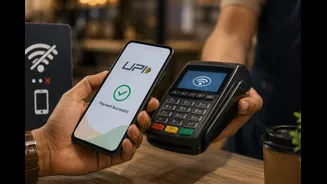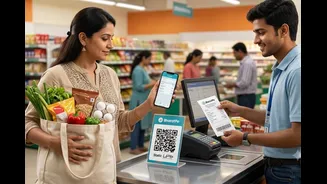








It’s Saturday and you decide to go grocery shopping. At your neighbourhood supermarket, your bill comes to Rs 3,200. You scan the shop’s UPI QR code, enter Rs 3,200 and hit pay.
The payment goes through.
But with the new UPI Merchant Discount Rate (MDR) kicking in from October 15, you may wonder: Will you now have to pay extra because you used UPI? In this case, no.
Under the new framework, a 0.4 per cent MDR will apply to specified person-to-merchant (P2M) UPI transactions above Rs 2,000. On a Rs 3,200 transaction, that works out to Rs 12. But that Rs 12 is a merchant-side charge within the payment ecosystem. It is not supposed to be added to your bill.
So, you pay Rs 3,200 and not Rs 3,212.
ALSO READ | UPI Charges Explained: Who Will Pay 0.4% MDR On Transactions Above ₹2,000? 10 Top FAQs Answered
That distinction is important because the phrase “UPI charges” can make it sound as if consumers will now have to pay every time they scan a QR code.
The government and NPCI have clarified that consumers will continue to use UPI without transaction charges. The new MDR applies to specified merchant-side transactions, while person-to-person payments remain free.
Here are eight things your bank, UPI app or merchant cannot simply charge you for under the new framework.
1. Your Bank Can’t Charge You For Sending Rs 3,200 To A Friend
Suppose the supermarket example changes. Instead of paying the shop, you send Rs 3,200 to your friend who bought concert tickets for both of you.
ALSO READ | ‘India Could Become A Cash Economy Again’: Ashneer Grover On Possible UPI Charges Above Rs 2,000
That remains a person-to-person, or P2P, UPI payment.
The new MDR does not apply to ordinary P2P transfers. So, sending Rs 3,200, Rs 10,000 or another amount to another person does not suddenly attract a 0.4 per cent UPI charge.
The Rs 2,000 figure is therefore not a limit above which every UPI payment becomes chargeable. It is relevant to specified merchant transactions. P2P payments remain free irrespective of the amount.
2. Your Bank Can’t Impose A UPI Charge On Payments Up To Rs 2,000
Now, take the supermarket bill down from Rs 3,200 to Rs 2,000.
The Finance Ministry’s September 14 notification says banks and system providers cannot impose a direct or indirect charge on UPI transactions up to Rs 2,000. So, if your bill is Rs 500, Rs 1,500 or exactly Rs 2,000, you should not suddenly see a UPI fee simply because you chose to pay digitally.
Importantly, this is not a Rs 2,000 daily or monthly free quota. It is a threshold in the merchant-side charging framework.
3. Your UPI App Can’t Simply Add A “Platform Fee” To Your Payment
Back to the original Rs 3,200 supermarket bill.
The merchant may have a Rs 12 MDR under the new standard structure. But that does not mean your UPI app can debit another Rs 12 from you by labelling it a “UPI platform fee”.
The new framework keeps the MDR within the payment ecosystem. UPI app providers are not supposed to impose a separate platform fee or other charge on the consumer for making the UPI payment.
So, the transaction should not become: Supermarket bill is Rs 3,200, UPI fee: Rs 12, so total debited is Rs 3,212. Thus, the MDR and the amount paid by the consumer are two different things.
4. Your Shopkeeper Can’t Simply Add MDR To Your Bill
This is likely to be the biggest practical question for consumers.
Suppose the supermarket owner tells you: “The bill is Rs 3,200. If you pay by UPI, it will be Rs 3,212.”
The new MDR framework does not provide for simply passing that Rs 12 MDR on to you as a UPI surcharge.
NPCI has directed acquiring banks to ensure that merchants do not pass the MDR on to customers. The purpose is to keep the charge within the payment ecosystem rather than turn it into a separate fee for the person making the payment.
There is an important distinction here, however. This does not mean a business can never change its prices. A merchant’s overall pricing decisions are a separate matter. What the framework does not permit is simply taking the MDR it has to bear and adding it to the customer’s bill as a mandatory UPI charge.
5. Your Rs 2,000 Shopping Bill Does Not Suddenly Attract MDR
What if your supermarket bill is exactly Rs 2,000? The new standard MDR threshold is for merchant transactions above Rs 2,000. So, the Rs 2,000 transaction remains outside that MDR structure.
The government’s separate notification also specifically protects UPI transactions up to Rs 2,000 from direct or indirect charges by banks and system providers.
That means:
Rs 1,999 → no MDR
Rs 2,000 → no MDR
Rs 2,001 → specified merchant transaction can enter the MDR framework
But this should not be read as saying a Rs 2,001 payment will cost the customer more. The MDR is a merchant-side charge.
6. Your Neighbourhood Kirana Shop May Continue With Zero MDR
Now, imagine that instead of a large supermarket, you are buying groceries worth Rs 3,200 from a small neighbourhood kirana shop.
The answer can be different depending on the merchant’s classification.
NPCI has retained a zero-MDR framework for eligible P2PM merchants—broadly, small merchants receiving up to Rs 1 lakh a month directly into their bank accounts through UPI QR payments.
So, some small vendors, street sellers and similar businesses can continue with zero MDR even when the individual payment is above Rs 2,000.
But don’t assume that every shop that looks small automatically qualifies. The exemption depends on the merchant meeting the applicable P2PM criteria.
7. There Is No New “Free UPI Quota” For Consumers
Another possible misunderstanding is that UPI will now work like some banking services where you get a limited number of free transactions and then start paying.
That is not what the new MDR framework does. There is no new rule saying you get, for example, 10 free UPI payments a month and then have to pay for the 11th.
Person-to-person payments remain free, while the new MDR applies to specified merchant transactions. So, if you send Rs 3,200 to one friend today and Rs 5,000 to another tomorrow, the new MDR does not suddenly kick in because you have crossed some monthly UPI usage limit.
8. Rs 2,000 Is Not A New UPI Payment Limit
Finally, perhaps the most important clarification: you can still make UPI payments above Rs 2,000.
The Rs 2,000 figure is not a new maximum amount for UPI. So, if your supermarket bill is Rs 3,200, you don’t have to make two payments of Rs 1,600 merely because of the new rule.
The merchant-side MDR on a standard transaction above Rs 2,000 would be calculated separately.
At the standard 0.4 per cent rate:
• Rs 3,000 payment → Rs 12 MDR
• Rs 5,000 → Rs 20
• Rs 10,000 → Rs 40
• Rs 50,000 → Rs 200
• Rs 75,000 → Rs 300
• Rs 1 lakh → Rs 300, because of the Rs 300 cap
These are merchant-side MDR amounts, not additional amounts that the consumer is supposed to pay.
So, What Actually Changes From October 15?
The simplest way to understand the new system is to go back to the Rs 3,200 supermarket bill.
You pay Rs 3,200 through UPI. For a standard eligible P2M transaction, the merchant may incur Rs 12 MDR. Your bank does not turn that into a Rs 12 UPI fee for you. Your UPI app does not simply add Rs 12 as a platform fee. The merchant is not supposed to recover its MDR from you by adding Rs 12 to the bill. And if the same Rs 3,200 is sent to a friend rather than a merchant, there is no MDR at all because it is a P2P transaction.
There are also separate MDR structures for certain categories. Fuel, telecom, insurance and railway payments above Rs 2,000 attract a Rs 5 MDR, while capital-market transactions have a separate 0.02 per cent rate, subject to a Rs 300 cap. These are merchant-side charges and should not be described as a blanket 0.4 per cent fee on every UPI payment above Rs 2,000.
The government says the new MDR is intended to create revenue for the UPI ecosystem and support investments in infrastructure, cybersecurity, resilience, innovation and customer service. At the same time, it has retained exemptions and lower structures for certain categories to limit the impact on smaller merchants and specific essential payments.