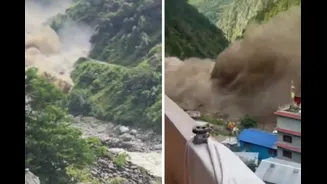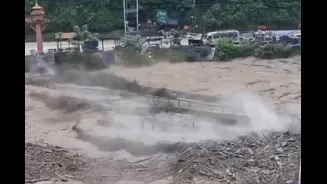








Bihar’s administration went on high alert on Wednesday morning after a sudden, massive flood tore through northern Nepal’s Rasuwa district, with authorities in West Champaran’s Bagaha area bracing for
a possible surge in the Gandak River within two to three hours as excess water flows downstream from the Bhote Koshi and Trishuli rivers into India.
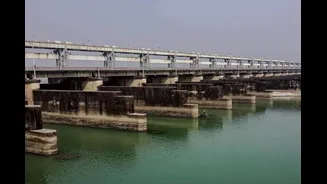
Security has been stepped up at the Valmikinagar Barrage, and officials across departments have been directed to remain on alert.
People living along the Gandak and in low-lying areas have been advised to take precautions and follow the administration’s instructions, officials said.
Chief Minister Samrat Choudhary addressed the impending danger on Wednesday, saying, “A high-level team has been constituted to look into the matter. The Chief Secretary and the DGP are personally monitoring the situation. I am also holding a meeting on the matter immediately.”
The alert follows a sudden, sharp rise in the Bhote Koshi’s water level in Nepal around 9 am local time, which the Nepal Army said caused widespread destruction in Timure and Syafrubesi, washing away vehicles, goods and a recently built bridge.
Nepal’s Department of Hydrology and Meteorology said the flooding wasn’t caused by rainfall, though some media reports — unverified so far — have attributed it to a Glacial Lake Outburst Flood (GLOF) near the Tibet border.
The Nepal Army has mobilised two helicopters, including one with an emergency medical rescue team, for search and rescue operations in Rasuwa and along the Trishuli River.
For Bihar, this is a familiar and dreaded pattern. Roughly 65% of the catchment area of the state’s major rivers — Kosi, Gandak, Burhi Gandak, Bagmati, Kamla Balan, Mahananda and the Adhwara group — lies in Nepal and Tibet, meaning heavy rain or sudden glacial floods upstream routinely translate into disaster downstream within hours.
Here’s a look back at the major flood events driven by Nepal’s rivers that have battered Bihar over the years.
1968: The Benchmark Disaster
Long before it became a modern reference point, 1968 set the historic high for water discharge from the Kosi’s Birpur Barrage — 7.88 lakh cusecs — a figure flood officials in Bihar still cite as the yardstick nearly six decades later.
2008: The Kosi’s Kushaha Breach
On August 18, 2008, the Kosi River burst through its eastern embankment at Kushaha in Nepal’s Sunsari district, just 8 km from the Indian border. The river shifted course by over 100 km, flooding areas untouched for decades. Official figures put the toll at around 434–493 deaths and up to 4 million people affected across Bihar, with more than 236,000 houses destroyed — one of the worst disasters in the state’s history.
2017: Floods Across 25 Districts
Heavy rainfall in early June, followed by continuous downpours in August, sent the Ganga and its tributaries surging. The Kosi breached its embankment near Kartarpur in Darbhanga, while the Bagmati and Gandak embankments were damaged in Sitamarhi and West Champaran, flooding the Valmiki Tiger Reserve. Over 25 districts were affected.
2019: Three Waves Over Four Months
Bihar faced repeated flooding through 2019, with the Mahananda, Bagmati, Kamla Balan, Adhwara, Burhi Gandak, Kosi, Sone, Punpun and Gandak rivers all in spate at various points, prompting satellite-based emergency monitoring by ISRO’s Disaster Support Cell to track the worst-hit areas.
September 2024: Highest Discharge Since 1968
Record monsoon rainfall in Nepal and north Bihar forced the Birpur Barrage to release 6.61 lakh cusecs from the Kosi — the highest since 1968 — while the Valmikinagar Barrage released 5.62 lakh cusecs from the Gandak, the highest since 2003. Embankments breached at seven points, displacing thousands and destroying standing crops across Darbhanga and neighbouring districts.
October 2025: Kosi, Mahananda Swell Again
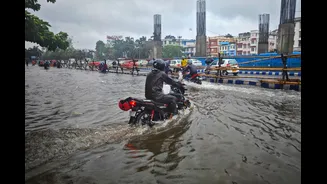
Continuous rainfall in Nepal’s Terai region and north Bihar pushed the Kosi and Mahananda above the danger mark, with all 56 gates of the Birpur Barrage opened and over 5.33 lakh cusecs released — the year’s highest discharge at the time.
With Wednesday’s Rasuwa flood adding to this long history, officials in Bagaha are watching the Gandak’s levels closely over the next few hours to determine whether Bihar faces yet another repeat of a pattern the state knows all too well.