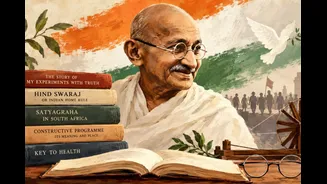




Gandhian principles are the moral, ethical and socio-political framework associated with Mahatma Gandhi, centred around truth, non-violence, self-discipline and the welfare of all. Even as India observes
Mahatma Gandhi’s 157th birth anniversary today, many of the ideas he advocated continue to find relevance in everyday life.
While Gandhi’s philosophy emerged in a very different social and political era, its principles can be interpreted in the context of modern India — from the way we communicate with one another to how we respond to injustice, consume products and engage with our communities.
Here are some of Gandhi’s core principles and ways they can be incorporated into contemporary life.
Satya (Truth)
Truth was at the heart of Gandhi’s philosophy. He regarded truth as fundamental to both personal conduct and public life.
In modern life, Satya can begin with something as simple as being honest at work, school, college or in personal relationships. But Gandhian truth is not simply about saying whatever comes to mind in the name of honesty. The manner in which truth is communicated matters too.
Consider the person who tells a friend, “I’m just being honest,” before criticising their appearance, or gives a colleague harsh feedback without considering how it will be received. Being truthful does not require being cruel or condescending.
Practising Satya today can therefore mean being honest while remaining empathetic — telling the truth without deliberately using it as a weapon.
Ahimsa (Non-violence)
Ahimsa, or non-violence, is perhaps the principle most closely associated with Gandhi. It goes beyond simply avoiding physical violence and can extend to our words, behaviour and treatment of other living beings.
In everyday life, Ahimsa can mean refusing to participate in online harassment, avoiding abusive language, treating domestic workers and service staff with dignity, and being mindful of cruelty towards animals.
At a larger level, the principle can also encourage people to think about the human and environmental consequences of development. Questions around deforestation, displacement, environmental degradation and the impact of infrastructure projects can be approached through the lens of minimising harm and considering the welfare of communities and ecosystems.
Satyagraha (Non-violent resistance)
Satyagraha refers to the pursuit and assertion of truth through non-violent resistance. For Gandhi, standing against injustice did not mean responding to violence with violence.
The principle remains relevant whenever people seek social or institutional change. Whether citizens are raising concerns about education, equality, women’s safety, environmental protection or other public issues, Satyagraha offers a framework for expressing dissent peacefully and persistently.
In the digital age, this can also mean using social media and other platforms to raise awareness without resorting to threats, abuse, misinformation or targeted harassment.
Sarvodaya (Welfare of all)
Sarvodaya broadly refers to the uplift and welfare of everyone, with an emphasis on collective progress rather than the advancement of a select few.
This principle has particular relevance in an era of social media, where conversations can quickly become divided between “us” and “them”. Online trolling, bullying and public shaming can make it easy to forget that there are real people behind usernames and profile pictures.
Applying Sarvodaya today could mean asking whether our choices contribute to a more inclusive society. It could involve supporting local communities, making workplaces more inclusive, helping people who have fewer resources and using one’s skills or influence to create opportunities for others.
Swadeshi (Self-reliance)
Gandhi’s idea of Swadeshi encouraged people to value locally produced goods and strengthen self-reliance. In his time, this was closely connected to the freedom movement and the promotion of Indian-made products.
In contemporary India, Swadeshi can be interpreted more broadly. It does not necessarily mean rejecting everything foreign. Instead, it can encourage consumers to understand where their products come from and consider supporting local artisans, farmers, small businesses and Indian manufacturers when practical.
Sarvodaya (Compassion)
Perhaps the most accessible way to understand Gandhian philosophy today is to bring it into ordinary interactions. Helping someone without expecting something in return, treating people with dignity regardless of their profession or social position, listening before judging and standing up against unfair treatment are all small ways of putting these principles into practice.