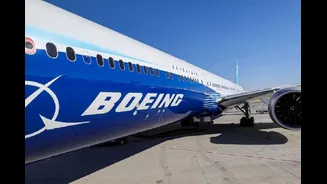

A deadly aircraft accident on the outskirts of Ahmedabad earlier this year had once again dragged Boeing, the world’s largest plane-maker, into the centre of a global debate on aviation safety. The crash,
involving an Air India Boeing 787-8 Dreamliner on June 12, revived long-standing questions about whether relentless delivery pressure inside Boeing factories has steadily eroded the company’s once-vaunted safety culture.
For critics, the Ahmedabad plane crash was not an isolated failure but part of a grim continuum that stretches back to the two Boeing 737 MAX disasters in 2018 and 2019. Together, these incidents claimed hundreds of lives and exposed uncomfortable fault lines in how modern commercial aircraft are built, tested and certified.
At the centre of this renewed scrutiny is Ed Pierson, a former senior Boeing manager who spent nearly a decade working on the company’s 737 and 787 programmes and now serves as executive director of the Foundation for Aviation Safety. In an extended conversation with Firstpost, Pierson painted a picture of a production ecosystem where schedule pressure routinely trumped caution, and where critical warnings from the factory floor failed to reach, or were ignored by, senior leadership.
Pierson said that Boeing’s public messaging about safety being its “number one priority” often masked a far harsher reality inside its manufacturing facilities. “There was incredible pressure to get the work done,” he said, adding, “At Boeing, the saying was always that the schedule is king. On paper, safety and quality come first, but when you’re standing on the factory floor, it doesn’t always feel that way.”
According to Pierson, the problem was not uniform across the organisation. Some teams, he said, refused to compromise and insisted on doing the job right. Others, operating under weaker leadership, cut corners to keep aircraft moving down the line. That inconsistency, he argued, created the most dangerous conditions of all.
The former manager traced many of these issues back to the 787 Dreamliner programme, where he said senior management was not being told “the full truth” about what was happening on the shop floor. Internal audits, he claimed, gradually revealed serious deficiencies in quality control, but by the time the scale of the problem became clear, flawed practices were already deeply embedded.
One of the most alarming patterns Pierson describes is what he calls “out-of-sequence work”. In theory, each stage of aircraft assembly must be completed before the plane advances to the next production phase. In practice, Pierson said, delays in parts or inspections often meant that unfinished work was simply deferred.
“If parts weren’t available or quality checks weren’t complete, the plane still moved forward,” he explained, “When the parts finally arrived, workers had to rush, grab their tools and squeeze the work in between other tasks. That’s downright dangerous.”
In the context of the Ahmedabad crash, Pierson pointed to familiar warning signs. He cited long working hours, employee fatigue and repeated technical issues involving flight control, electrical, hydraulic and pressurisation systems. Functional tests, designed to assess the health of the entire aircraft, were reportedly failing, he said, while supply-chain disruptions forced mechanics to complete installations hastily and out of order.
“These are human-built machines, and humans can make mistakes,” Pierson said, “But when people are exhausted and under extreme pressure, those mistakes can reach catastrophic levels.”
Pierson also expressed deep concern over how the immediate aftermath of the June 12 crash was handled. Reports of a tail stabiliser alert on the aircraft, he noted, were quickly dismissed by investigators. Only fragments of cockpit audio were released, while data from the flight data recorder, ACARS and aircraft health monitoring systems were absent from the preliminary findings.
“To be honest, the initial report was very poor,” Pierson said, “Before anyone even thinks of blaming the pilots, who are no longer here to defend themselves, every technical aspect has to be examined thoroughly.”
That warning was sharpened by his criticism of sections of the international media, including early reporting that suggested pilot error. “In one word, it’s disgusting,” he said, “The 787 is an electrical monster, incredibly complex. Systems can and do fail. To jump to conclusions without a full investigation is irresponsible.”
Pierson argued that this tendency to shift blame onto flight crews is not new. He cited earlier cases such as Ethiopian Airlines Flight 302 and EgyptAir Flight 990, where pilots were swiftly faulted before manufacturing or maintenance failures were fully explored. “There’s a pattern,” he said, “First sympathy, then blame the pilots, because acknowledging deeper flaws opens the door to massive legal and financial consequences.”
Regulators, Pierson said, have also fallen short. He was particularly critical of the US Federal Aviation Administration and the National Transportation Safety Board, saying both have grown too dependent on Boeing. Documents highlighting electrical issues on the 737 MAX, he claimed, were not adequately shared with investigators. In contrast, he described the Indian Supreme Court’s intervention in the Ahmedabad case as “commendable”.
At its core, Pierson insists, Boeing’s crisis is cultural rather than purely technical. Safety, he said, cannot rest solely on pilots’ shoulders. Mechanics, technicians and inspectors must also be empowered to speak up when they are fatigued or unfit to work. “These aircraft will be flying for 30 years,” he said, “Human factors apply to everyone involved in building them.”
Financial pressure, he added, has only intensified the problem. After years of losses, Boeing is under immense strain to reassure investors and ramp up deliveries. But Pierson argues that prioritising Wall Street over workmanship is a recipe for disaster. “If products are faulty, fix them first,” he said, “Build planes to the highest quality standards. Denying problems doesn’t make them disappear, the proof is in the pudding.”
Perhaps his strongest remarks were reserved for the question of accountability. Pierson believes that without criminal consequences for senior decision-makers, meaningful reform is unlikely. “This is gross negligence,” he said, “Pushing aircraft out the door to meet delivery targets, knowing there are safety risks, is criminal behaviour.”
Would he fly on a Boeing jet today? His answer was unequivocal. “No,” he said, ruling out both the 737 MAX and, for now, the 787 Dreamliner. Similar manufacturing flaws, he warned, are emerging across programmes, and until regulators do their job properly, he would not recommend flying on them.