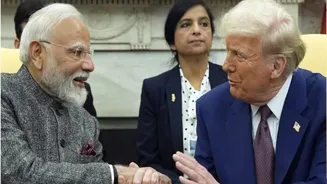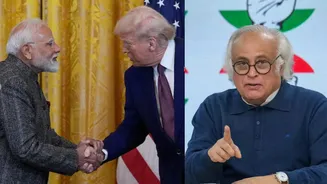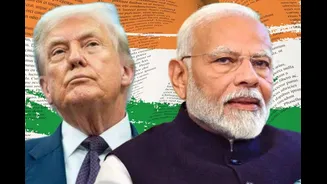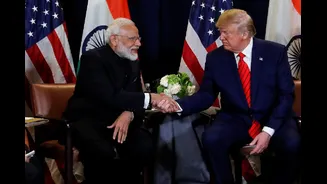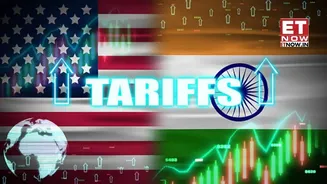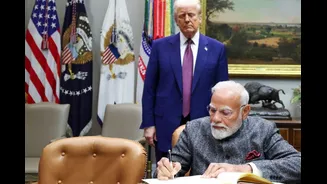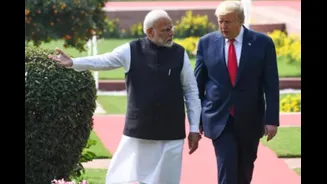

Ending months of tense negotiations and friction in ties, India and the United States on Monday finalised a trade deal that slashed US tariffs on Indian goods to 18 per cent from 50 per cent. US President
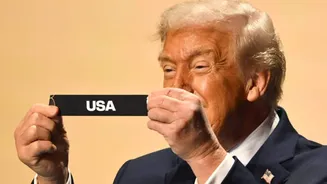
Donald Trump announced the deal on social media following a call with Prime Minister Narendra Modi, noting that India had agreed to halt Russian oil purchases and lower trade barriers on US exports—a commitment that India has not yet commented on.
Indian stock markets and the rupee have been battered since the tariffs were levied by Washington in late August, placing them among the worst-performing emerging market assets in 2025, with record foreign investor outflows. According to Reuters, the trade breakthrough is expected to alleviate the persistent drag, with investors expecting a bounce-back in foreign sentiment and flows into Indian assets.
The trade deal is also expected to lift a pall of geopolitical uncertainty, which had accompanied the US-India trade rift, keeping investors cautious on plowing money into the country.
In a press note, economists at Citi said: “The key tail risk of geopolitical isolation about which investors were concerned has now been adequately addressed by back-to-back trade deals with the European Union and United States.”
Sachin Savareekar (Artha India Investment Managers) said on the deal’s economic significance that it could turn sentiment around and make India a stronger player in global trade. “This trade deal gives one of the most important economic partnerships new strength and strengthens investor confidence.”
However, there were many who exercised caution, warning that the deal had political and strategic trade-offs—not just market benefits.
For instance, Ajay Srivastava, Founder, Global Trade Research Initiative (GTRI), criticised the context of the agreement, arguing that “a hasty deal under pressure could backfire … and may not provide lasting trade certainty”. His point reflected a broader caution among trade policy experts that such arrangements, especially tied to geopolitical moves like the Russian oil issue, might lock in uneven terms.
While South Asia analyst Michael Kugelman described the deal as fortifying overall bilateral ties and offering a “positive backdrop for US‑India relations”, he said he “highly doubt Modi agreed to stop buying Russian oil, as Trump claimed”.
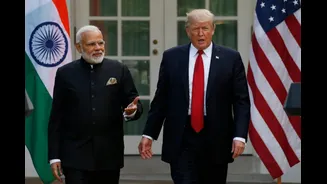
Speaking to news agency ANI, Kugelman said: “This deal has been a long time coming. It’s been almost a year since President Trump hosted Prime Minister Modi at the White House, and they promised to pursue a trade deal… Given the numerous failed rounds of talks, for a deal to happen now is significant and a major boost for US-India relations. This is the biggest victory for US-India relations in nearly a year…”
However, he added: “While President Trump indicated that India has agreed to stop certain actions, some of these claims seem hard to believe. For instance, I find it hard to imagine India simply stopping its imports of Russian oil… Trump also mentioned India importing more American goods, but many key aspects of the deal remain unclear… One major question is whether the US has made any concessions to India…”
I highly doubt Modi “agreed to stop buying” Russian oil, as Trump claimed. India has, however, reduced its Russian oil imports since the new US Russia sanctions were instituted in November. That, along w/Amb Gor’s push for a deal, likely helped get them to the finish line.
— Michael Kugelman (@MichaelKugelman) February 2, 2026
Similarly, leading Asia expert and former Treasury Secretary Evan A Feigenbaum cautioned against overreacting. While he acknowledged the deal as positive news that prevents worse outcomes and notes that the 18 per cent tariff is a relief compared to the previous 50 per cent, he makes it clear that tariffs are inherently unstable because of Trump’s style: he changes rules, layers issues, and imposes them unpredictably. Saying the “devil is in the details”, he cautions that India is unlikely to make explicit commitments regarding Russian oil, which could create friction.
Feigenbaum says the deal restores some progress in US-India relations, but recent politicisation has created “collateral damage”.
My advice on the U.S.-India deal … everyone seriously needs to take a deep breath and calm down.
First, the situation was utterly unsustainable, which is why my base case since last August has been that there would ultimately have to be a deal. I've been saying this on @CNBC…
— Evan A. Feigenbaum (@EvanFeigenbaum) February 2, 2026
Several analysts noted that while the US-India trade deal represents a pivotal moment in bilateral relations, offering a much-needed pause after months of high tariffs, political tension, and uncertainty, the real significance lies in stabilising a relationship that had been increasingly politicised, and in providing Indian exporters a relative advantage in the global market.
Ultimately, the trade agreement is both a relief and a reminder. As Feigenbaum concludes, “Modi and Trump should take the win … But … take a big deep breath and see where we go from here.” The deal marks progress, but the work of maintaining trust, managing domestic and foreign political pressures, and ensuring that long-standing cooperative frameworks are preserved remains ongoing.