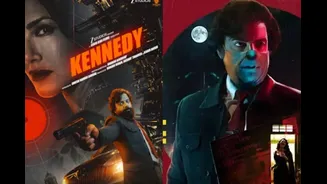





Dark, macabre, gritty and criminally undervalued, Anurag Kashyap’s Kennedy drifted for nearly three years in a peculiar cinematic purgatory. It drew a standing ovation at Cannes, travelled the festival
circuit like a whispered legend, provoked discussion in distant auditoriums, and yet remained strangely inaccessible to the audience it was born from. Its arrival on ZEE5 feels less like a conventional premiere and more like the unsealing of something long buried. What surfaces is not merely a thriller but a delirium steeped in guilt, power and systemic decay. The film does not invite comfort. It unsettles, seduces and then refuses to leave.
There is something almost poetic about its delayed homecoming. A film born in chaos, shaped by the emotional and ideological turbulence of its maker, and released into a world that has already lived through the trauma it depicts. Kennedy juxtaposes the stark realities of the pandemic with an internal apocalypse. It begins as a slow ember, restrained and observant, before swelling into a moral inferno by its final act. It refuses to sit neatly within the contours of conventional neo-noir. Instead, it dismantles that binary entirely, bending genre into something more psychologically corrosive.
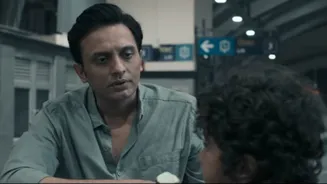
The story unfolds in a pandemic-scarred Mumbai, a metropolis rendered spectral. Streets lie vacant, faces disappear behind masks, news bulletins flicker like anxious pulse beats. Kashyap frames the city almost like a graphic novel in motion, drenched in shadows, heightened by operatic crescendos and jazzy undertones. The silence of lockdown becomes a character in itself. At the centre stands Kennedy, embodied by Rahul Bhat with unnerving restraint. By night he is an insomniac chauffeur for a luxury ride service. Beneath that anonymity lives a contract killer, deployed quietly by Police Commissioner Rasheed Khan, played with chilling composure by Mohit Takalkar.
Kennedy was once Uday Shetty, an idealistic yet impulsive cop who joined the force to combat corruption, only to become entangled in it. Alongside Rasheed and Inspector Abhijit Kale, portrayed by Shrikant Yadav, he pursued the gangster Saleem. During a tense interrogation at the apartment of Saleem’s associate Gunjan, Uday accidentally kills her brother Chandan while attempting to force a confession. What begins as intimidation spirals into fatal excess. The media brands him a “killer cop.” Public fury erupts. The system that once applauded aggression now demands sacrifice.
Retaliation is swift and merciless. Saleem plants explosives in Uday’s family car, killing his young son Adi in a blast that detonates not just metal but whatever remained of Uday’s moral equilibrium. Grief hollows him out. His wife confronts the “animal” growing inside him and demands separation for the safety of their daughter Aditi. With Rasheed’s help, Uday stages his disappearance. Reports speak of abduction and presumed death. Uday Shetty dissolves into rumour. Kennedy takes his place.
Reconstructed as a ghost within the system, Kennedy lives in isolation, obsessively monitoring his estranged family through hidden cameras he installed before vanishing. He becomes Rasheed’s silent executioner, trading obedience for the promise of eventual revenge against Saleem. His killings are swift and disturbingly efficient. A businessman’s throat is slit in a luxury apartment; Kennedy calmly swaps his bloodied coat for one from the wardrobe and melts back into pandemic anonymity. When Rasheed fails to bribe an incorruptible aide from the chief minister’s inner circle, Kennedy is dispatched to eliminate the aide and his entire family in a chilling sequence that underscores how desensitised he has become. The line between good and evil has long dissolved. What remains is mechanical precision.
Kennedy is an enigma. His signature mask is instantly arresting. He wears it not merely as protection from a virus but perhaps as insulation from his own conscience. His muscular, imposing frame contrasts sharply with the emptiness in his eyes. There is a chilling moment in the way he studies people wearing masks incorrectly, as though moral failure and pandemic negligence belong in the same category of irritation. He derives a twisted thrill from watching life ebb from his victims’ eyes, yet his chronic sleeplessness betrays buried guilt. Chandan’s ghost lingers like unfinished business. Kennedy is less a man than a walking echo of institutional corruption.
Rasheed’s manipulation grows increasingly insidious. He convinces Kennedy to plant explosives in a reformed bookie’s car outside the Modemar hotel, assuring him it will not detonate. Kennedy triggers it deliberately, sowing chaos. Later, the shaken bookie is delivered to Kale for a staged suicide. In a pandemic economy where bribery pipelines have dried up, corruption mutates into something more brazen. The cops resemble organised crime syndicates scrambling to compensate for financial drought.
The violence escalates after Kennedy kills Akbar, Saleem’s nephew, delivering a mocking “Salaam” that announces his resurrection. Saleem demands his head. Rasheed, desperate to preserve his leverage, aligns with Saleem and sets a trap using Charlie.
Charlie, portrayed by Sunny Leone with layered vulnerability, is introduced as Kabir’s lover, Kabir being a restaurateur indebted to Rasheed. Treated as currency, she is demanded as repayment. Charlie is both resilient and fragile, projecting allure while concealing dread. Her peculiar, dry laugh, often erupting in inappropriately sombre moments, functions as armour against humiliation and fear. It is the laugh of someone disassociating from absurd cruelty. When Kabir is murdered on Rasheed’s orders and Charlie unknowingly rides in Kennedy’s cab that same night, recognising Kabir’s stolen bag, suspicion ignites. She senses something fractured within Kennedy and repeatedly reaches out, hoping for redemption he barely believes in.
When Rasheed lures Kennedy to Charlie’s apartment through coercion, Kennedy anticipates betrayal. The confrontation is brutal. Kale is defeated. Saleem shoots Kennedy in the arm but is ultimately overpowered and fatally stabbed. To free Charlie from Gunjan’s grip, Kennedy shoots her arm to disarm her and leaves her fourteen lakh rupees for Aditi. It is a gesture that hints at remorse, though it can never balance the scales.
The final reckoning arrives when Kennedy confronts and kills Rasheed. Sirens wail. He calls his ex-wife. Silence answers. He uploads incriminating footage from his hidden cameras, exposing corruption online. He texts Aditi. “I love you” becomes an apology. The ghosts remain.
The ambiguity of the ending is its final cruelty. Kennedy places a gun in his mouth as Aditi’s call rings. Cut to black. The film withholds resolution, forcing the audience to sit with discomfort rather than closure.
What elevates Kennedy beyond genre is its political sharpness. Pandemic rituals such as thaali-banging and diya-lighting are revisited through biting dialogue, reframed as hollow spectacle against widespread cremations and suffering. An overzealous journalist caricatures media hysteria. Casual conversations hint at billionaires thriving while ordinary citizens struggle, suggesting that power resides less in elected governments and more in tycoons who pull invisible strings. References to bomb scares and extortion rackets underline institutional decay. The film does not shout its politics. It murmurs them, trusting the audience to listen.
The music deepens this atmosphere. An operatic score merges seamlessly with Aamir Aziz’s poetry and Boyblanck’s jazz-inflected compositions. Mera Mehboob and Kabhi Tu Bhi Roke Dekh operate as both narrative propulsion and political commentary. Tchaikovsky’s The Sound of Kennedy, performed by The City of Prague Philharmonic Orchestra, becomes the film’s aching backbone, its eleven-minute swell mirroring Kennedy’s psychological unraveling.
Rahul Bhat’s performance anchors everything. His weary gait, hollow stares and raspy baritone convey trauma without overt theatrics. Through much of the first half, you expect him to choose restraint. He does not. His victims are often ordinary, even upright, sharpening your moral discomfort. And yet, Kashyap manipulates you into searching for cracks in his armour. By the time the credits roll, you may not forgive Kennedy, but you understand the machinery that built him.
The film’s slow-burning structure demands patience. Its non-linear storytelling can disorient inattentive viewers. The pacing occasionally stretches. But these fissures pale beside its immersive night cinematography, haunting performances and the twisted crescendo of its climax.
Mohit Takalkar embodies Rasheed with sleazy conviction. Abhilash Thapliyal’s Chandan lingers as a spectral conscience. Shrikant Yadav, Megha Burman, Kurush Deboo, Aamir Dalvi and Karishma Modi fortify the narrative’s moral scaffolding.
In the end, Kennedy defies neat categorisation. It is a crime thriller that doubles as a political lament and a psychological autopsy. It deserved the expanse of the silver screen. Yet even on streaming, it stands tall. For Kashyap, who has moved from the grounded intensity of Nishaanchi to the cerebral intrigue of Dobaraa, Kennedy remains one of his most haunting provocations yet.
![New OTT releases you shouldn’t miss this week [Feb 16 – Feb 22, 2026]](https://g-mob.glance-cdn.com/public/fc/image/P76FcOEqHXq0.webp)