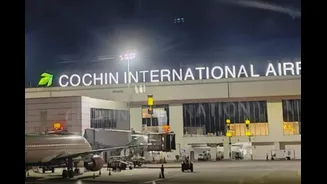

Airports are usually built through state planning and government policy approvals. But in Kerala, one airport followed a very different path that was shaped not by authority alone but by collective belief
and shared responsibility.
That idea eventually took form as Cochin International Airport (CIAL) in Kochi. An Instagram video now revisits how this ambitious project came to life at a time when Kerala had a large global workforce but lacked a world-class international gateway.
When An Airport Sounded Like An Unreal Idea
In the early 1990s, proposing an international airport in Kerala itself was considered bold. Suggesting that it could be built without direct government funding made it seem nearly impossible. Large infrastructure projects were not imagined outside state control or corporate backing at the time.
The narrator notes, “In the early 90s, building an international airport wasn’t just ambitious, it was unthinkable.”
The Man Who Refused To Wait
At the centre of this idea was V.J. Kurian, an IAS officer who chose not to accept delays. With limited funding options and repeated roadblocks, Kurian realised that the conventional model would not work.
As the video puts it, “No government funds. No private conglomerate. Just a vision.” Instead of waiting for approvals, Kurian reimagined the process itself. He turned to the people of Kerala, both at home and abroad and asked them to become stakeholders in the project.
Built By Citizens, Not Corporates
What followed was an unprecedented response. Nearly 10,000 investors came together to support the project. “10,000 investors – ordinary, Malayalis, NRIs, farmers and entrepreneurs – all came together to build what would become Cochin International Airport (CIAL),” the video explained.
This public participation formed the foundation of Cochin International Airport Limited (CIAL) which became India’s first major airport built through a people-driven public-private partnership (PPP) model.
Turning A Swamp Into An Airport
The challenges did not end with funding. The site chosen at Nedumbassery was a swampy stretch of land that required extensive development. Environmental concerns, political resistance and bureaucratic delays followed at every stage.
The video recalls this phase clearly: “Permissions, politics and funding – everything was a battle.” Despite doubts from many quarters, work continued steadily.
View this post on Instagram
The First Take-Off
In 1999, the first aircraft took off from Cochin International Airport. It marked more than the opening of an aviation facility. It was the result of years of persistence and public trust coming together.
As the video notes, “It wasn’t just an airport opening, it was Kerala taking flight.”
Redefining Sustainability In Aviation
Over time, CIAL went on to achieve several milestones. It became the world’s first fully solar-powered airport which operates with more than 46,000 solar panels and generates surplus energy.
The airport also introduced Kerala’s first private terminal and earned global recognition for sustainable efficiency and innovation.
Growth And Expansion Over The Years
Leadership at CIAL has evolved, with IAS officer A.S. Suhas currently at the helm. Under his leadership, the airport has continued to expand its capacity and reach.
Passenger numbers have grown from a few thousand in its early years to over 10 million annually. Today, CIAL connects Kerala to more than 40 international destinations and consistently ranks among India’s top 10 busiest airports while remaining profitable.