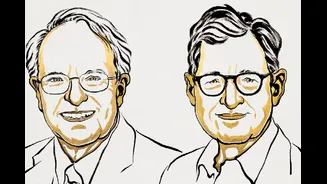









The Royal Swedish Academy of Sciences on Monday awarded the 2026 Sveriges Riksbank Prize in Economic Sciences in Memory of Alfred Nobel to Robert E. Hall and Michael Woodford for their work on the “microeconomic
foundations of macroeconomic stabilisation”.
The Royal Swedish Academy of Sciences recognised the economists for developing macroeconomic models that have significantly improved the ability of governments and central banks to implement effective stabilisation policies.
Their work shows how well-timed fiscal and monetary policy measures can help smooth economic fluctuations, reducing the severity of downturns and restraining overheating during periods of rapid growth.
Economic stabilisation has been a key policy objective since economist John Maynard Keynes developed his theories nearly a century ago. During recessions, governments and central banks typically seek to stimulate economic activity by lowering interest rates and increasing budget deficits. Conversely, policy measures are used to cool an overheating economy.
However, the oil crises of the 1970s exposed shortcomings in the Keynesian models then in use. Attempts to stabilise the economy failed to reduce unemployment and instead contributed to uncontrolled inflation, leaving Western economies grappling with low growth, high unemployment and high inflation.
Hall and Woodford helped revitalise stabilisation policy by building economic models on microeconomic foundations rather than relying solely on statistical relationships between macroeconomic variables such as inflation, production and consumption.
Their approach examines how the decisions of individual households and businesses collectively shape the wider economy. A central feature of these models is that households and businesses are forward-looking when making decisions about savings and prices.
By communicating their policy plans, governments and central banks can influence expectations about the future and help steer economic activity. The models have since proved useful in addressing economic downturns.
“The laureates’ work has provided us with a stable theoretical foundation for the models that are now used by central banks and governments around the world. With them, we are better equipped to deal with shocks in the economy, such as energy crises or sudden changes in how much households consume,” said John Hassler, chair of the Committee for the Prize in Economic Sciences.
The announcement marks the conclusion of this year’s Nobel Prize announcements.