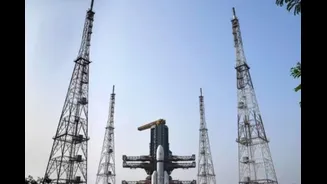









The Indian Space Research Organisation (ISRO) launched the BlueBird Block-2 satellite this morning aboard its Launch Vehicle Mark-3 (LVM3-M6) rocket from the Satish Dhawan Space Centre, Sriharikota. The mission
was scheduled to lift off at 8:55 am, with the satellite expected to separate from the rocket roughly 15 minutes later.
BlueBird Block-2 weighs about 6100 kilograms, making it the heaviest payload ISRO has sent into Low Earth Orbit (LEO) using LVM3. The launch is being carried out under a commercial agreement facilitated by NewSpace India Limited (NSIL), ISRO’s commercial arm.
Liftoff!#LVM3M6 launches the BlueBird Block-2 spacecraft from SDSC SHAR.
Youtube Livestreaming link:https://t.co/FMYCs31L3j
For More information Visit:https://t.co/PBYwLU4Ogy
#LVM3M6 #BlueBirdBlock2 #ISRO #NSIL— ISRO (@isro) December 24, 2025
Today’s operation reflects two trends shaping India’s evolving space sector: the rising international demand for direct-to-mobile satellites and the growing role of LVM3 in commercial contracts.
With this launch, LVM3 undertakes its third fully commercial mission, sixth operational flight, ninth mission overall, and adds to ISRO’s tally as the agency’s 101st launch and fifth mission of the year.
What BlueBird Block-2 Is Designed To Do
BlueBird Block-2 is the latest in a next-generation LEO satellite constellation designed to provide mobile connectivity directly from space to ordinary smartphones. The satellite is built to support 4G and 5G voice calls, video calls, text messaging, streaming and broadband data without needing satellite phones, special antennas, or any hardware modification on the user’s device.
A standout feature is its 223-square-metre phased-array antenna, the largest commercial communications antenna ever deployed in low-Earth orbit. Once it unfolds in space, the antenna forms more than 5600 signal cells, enabling the satellite to detect the faint signals transmitted by everyday mobile phones. This allows BlueBird Block-2 to provide coverage over regions where terrestrial networks cannot reach, including the Himalayas, remote deserts, oceans, dense forests and disaster-affected areas.
Five earlier BlueBird satellites were launched in 2024, forming the first segment of the global constellation planned by AST SpaceMobile, the US-based operator behind the project. The company already has partnerships with more than 50 mobile operators worldwide, and the initial service footprint of the constellation is expected to deliver near-complete coverage across the United States, followed by gradual expansion into international regions.
How BlueBird Block-2 Works Differently From Traditional Satellite Systems
Unlike conventional satellite communication platforms that require dishes or terminals, BlueBird Block-2 functions as a mobile tower in space. When a user moves beyond the reach of terrestrial coverage, the smartphone signal travels directly to the satellite overhead. The spacecraft then relays the signal to a gateway on the ground, from where it enters the user’s mobile operator network.
These gateways also compensate for natural delays and frequency shifts caused by the satellite’s orbital motion, ensuring stable connectivity. Only a small number of gateways are required in each country, allowing the network to reach areas where laying towers or fibre is impractical.
As more satellites join the BlueBird constellation, the system will be able to perform seamless handovers between spacecraft, helping maintain connectivity even when one satellite moves out of view. This makes the constellation useful not only for remote connectivity but also for emergency communication when ground networks fail.
Why The Payload Sets A New Benchmark For LVM3
At approximately 6100 kilograms, BlueBird Block-2 is the heaviest LEO satellite ever launched on LVM3. The rocket previously carried heavy payloads such as the CMS-03 communication satellite and 72 OneWeb satellites across two missions, but the current payload surpasses all earlier LEO deployments.
BlueBird Block-2 will be placed in a 520-kilometre circular orbit at an inclination of 53 degrees. The satellite is expected to separate from the rocket at around 942 seconds after lift-off, reaching a semi-major axis of 6898 kilometres.
How LVM3 Carries Out The Launch
LVM3 is ISRO’s most powerful operational rocket. It stands 43.5 metres tall, has a lift-off mass of 640 tonnes and uses a large 5-metre-diameter payload fairing to accommodate satellites with wide antennas or large structures.
The rocket operates using three stages:
- Two large solid strap-on boosters for initial thrust
- A liquid-propellant core stage for mid-ascent
- A cryogenic upper stage for final orbital insertion
In previous years, the LVM3 rocket powered landmark missions such as Chandrayaan-2, Chandrayaan-3 and the two OneWeb launches, building a record of reliable performance.
Why This Launch Matters For ISRO’s Commercial Future
The BlueBird Block-2 mission signals how ISRO is positioning itself within the rapidly growing global market for LEO communication satellites. Direct-to-device networks are emerging as one of the most significant shifts in telecom infrastructure, and they require rockets capable of carrying large, heavily equipped satellites with wide antennas. LVM3’s role in this segment strengthens India’s position as a launch provider for new-age connectivity systems.
The mission also reflects the expanding mandate of NSIL, which handles commercial launches for international customers and has become central to India’s space-economy strategy. With more operators worldwide seeking cost-effective and dependable launch options, missions like today’s illustrate how India is being integrated into global connectivity projects.
What Happens After BlueBird Block-2 Reaches Orbit
Once the satellite separates from the upper stage, it will begin a phase of deployment and testing. The large antenna will be unfolded in space, followed by checks to ensure each segment is functioning correctly. The satellite will then undergo calibration and communication tests before being integrated into AST SpaceMobile’s wider constellation.
Commercial rollout will depend on the deployment of additional satellites, readiness of ground gateways and regulatory approvals across various countries. But once operational, the BlueBird constellation aims to make mobile coverage possible in areas where it has never existed and ensure continuity during emergencies when ground networks fail.
For India, the launch caps the year with a demonstration of ISRO’s ability to deploy a heavy, technologically advanced satellite for a global telecom operator, a signal of where the country’s commercial space programme is headed in the coming years.