






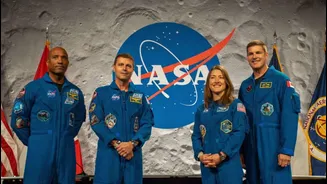

US space agency NASA is preparing to launch Artemis II, its first crewed Moon mission in more than 50 years, marking a return to deep space after a gap of over five decades. The mission, targeted for April,
will send four astronauts on a 10-day journey around the Moon — not to land yet, but to test systems critical for future lunar missions.
The last time humans travelled to the Moon was during Apollo 17 in December 1972, when an era driven by Cold War rivalry came to an end after 24 astronauts made the journey and 12 walked on its surface. Artemis represents a shift from those short visits to a long-term presence, built around new technology and commercial partnerships.
Artemis II is the first crewed step in that plan, and will take astronauts farther into space than any human has gone since the Apollo era, laying the groundwork for future landings and sustained missions on the lunar surface.
When Will Artemis II Launch And Why Has It Been Delayed?
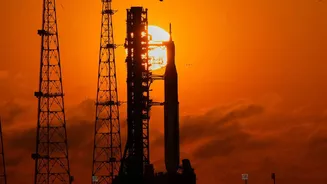
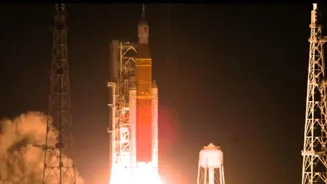
NASA is currently targeting April 1 with a planned liftoff at 6:24 pm EDT (3:54 am IST on April 2) from Launch Pad 39B at the Kennedy Space Center in Florida. The agency has a two-hour launch window on that day, meaning the rocket could lift off anytime between 6:24 pm and 8:24 pm EDT (3:54 am to 5:54 am IST on April 2).
Additional launch opportunities are available daily from April 1 to April 6, and again on April 30, though the exact timing shifts slightly each day. NASA has said it can attempt up to four launches within a given window, given the complexity of fuelling and preparing the Space Launch System rocket.
The timeline has already been pushed back. A February launch was ruled out after a hydrogen leak during a full pre-launch test, known as a wet dress rehearsal. A subsequent helium leak forced planners to move beyond March. Even after technical issues are resolved, mission planners must wait for the Moon to be in the right position in its orbit.
How Long Will The Mission Last And What Path Will It Take?
Artemis II is designed as a 10-day mission, but its trajectory is carefully structured to test deep-space operations under real conditions.
After liftoff, the Space Launch System (SLS) — making its first crewed flight — will place the Orion spacecraft into Earth orbit. Once initial checks are complete, Orion will perform a burn that sends it on a trajectory toward the Moon.
The spacecraft will spend a couple of days in orbit, take around four days to reach the Moon, and another four days to return. The mission will follow a free-return trajectory, looping behind the Moon and using its gravity to guide the spacecraft naturally back to Earth. This approach allows NASA to test navigation and deep-space flight while ensuring a built-in path home even in the event of major system failures.
Who Are The Astronauts Flying On Artemis II?
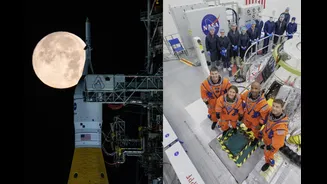
The mission will carry four astronauts: Reid Wiseman as commander, Victor Glover as pilot, and Christina Koch and Jeremy Hansen as mission specialists. Hansen represents the Canadian Space Agency, while the others are from NASA.
The crew reflects a broader push toward international and inclusive space exploration. Koch is set to become the first woman to travel to the Moon’s vicinity, Glover the first person of colour, and Hansen the first non-American astronaut to undertake such a mission.
What Will Astronauts Do During The Artemis II Mission?
Artemis II is not a landing mission, but it is far from symbolic. It is designed as a comprehensive systems test for both the Orion spacecraft and human operations in deep space.
Once in orbit, astronauts will begin by evaluating how Orion handles, including manually flying the capsule to practise steering and alignment — critical skills for future docking and landing missions. During the journey, the crew will conduct a series of checkouts and demonstrations to validate the spacecraft’s systems.
As Orion travels outward, it will carry astronauts thousands of kilometres beyond the Moon, taking them farther into space than any human has gone before. In this phase, the crew will assess life-support, propulsion, navigation, communication and power systems under real mission conditions.
The astronauts will also act as medical test subjects, collecting data on how the human body responds to deep-space travel and transmitting imagery back to Earth. They will work inside a small cabin in weightlessness, facing conditions that are more demanding than those aboard the International Space Station.
How Will The Mission End?
After looping around the Moon, Orion will begin its return journey. The spacecraft will re-enter Earth’s atmosphere at high speed, leading to a physically intense descent before splashing down in the Pacific Ocean off the west coast of the United States.
This phase is critical, as it tests the spacecraft’s ability to safely return astronauts from deep space, something not attempted since the Apollo missions.
Will Artemis II Land On The Moon? What Comes Next?
Artemis II will not land on the Moon. Its purpose is to validate systems and procedures required for more complex missions that follow.
NASA plans to carry out another crewed mission, Artemis III, in 2027 to rehearse operations such as rendezvous and docking with lunar landers and to test new spacesuits if they are ready. Artemis IV, planned for 2028, is expected to carry astronauts to the Moon’s south pole for a landing, with Artemis V later aiming to expand capabilities further.
NASA has selected two competing commercial landers — SpaceX’s Starship and a system developed by Blue Origin — and will decide closer to the time which vehicles are used for specific missions.
Why Is The Moon’s South Pole The Focus Of Future Missions?
Future Artemis missions are targeting the Moon’s south pole because of the potential presence of water ice. This resource could be crucial for long-term human presence, as it can be converted into oxygen for breathing and hydrogen for fuel.
What Is NASA’s Long-Term Artemis Plan?
NASA’s ambitions go beyond individual missions. The agency has paused work on its planned Gateway space station in lunar orbit for now, and is instead focusing on building capabilities directly on and around the Moon.
Future missions aim to establish a sustained human presence through repeated landings, surface infrastructure, robotic rovers and longer-duration stays. More countries are expected to join the effort, with astronauts from a widening group of nations living and working on and around the Moon.
How Does Artemis Fit Into The Global Race To The Moon?
The return to the Moon is now a global effort. China is targeting a crewed landing near the lunar south pole by around 2030, while Russia continues to outline plans for missions and a possible base in the early 2030s, though those timelines remain uncertain.
India, following the success of Chandrayaan-3 in 2023, has also expressed ambitions to eventually send astronauts to the Moon as part of expanding its human spaceflight programme beyond low-Earth orbit. European and Japanese astronauts are expected to participate in later Artemis missions as well.