







Brazil’s President Luiz Inácio Lula da Silva has secured another term in office, defeating Flávio Bolsonaro, the son of former president Jair Bolsonaro, in a closely fought presidential runoff. The October
25 verdict gives the 80-year-old left-wing leader a fourth, non-consecutive term and carries implications that extend well beyond Brazil’s borders.
For India, Lula’s victory is significant not simply because it preserves continuity in a key bilateral relationship, but because it comes at a time when trade tensions, the US-China rivalry and debates over the future of the global order are reshaping international diplomacy.
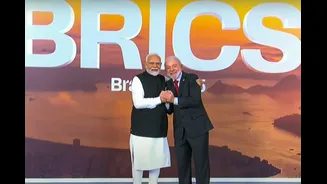
Brazil is India’s largest trading partner in Latin America, a fellow member of BRICS and an important voice among developing economies. With Lula returning to office, New Delhi has an opportunity to deepen a partnership that increasingly spans trade, technology, energy, critical minerals and global governance.
Why Lula’s Win Matters To New Delhi
Lula’s victory comes against a broader backdrop of political change across Latin America, where right-wing leaders aligned with US President Donald Trump have gained ground. Flávio Bolsonaro’s campaign offered the prospect of a closer political alignment between Brasilia and Washington. Lula’s re-election, by contrast, preserves his emphasis on strategic autonomy, multilateralism and stronger cooperation among emerging economies.
India has sought to maintain constructive relations with both Washington and Beijing while expanding its engagement with the Global South.
It does not mean Brazil will move away from the United States or automatically align with India on every international issue. Rather, Lula’s return offers continuity in a relationship built around the principle that developing countries should have a greater say in shaping global rules.
Prime Minister Narendra Modi articulated that shared ambition during Lula’s state visit to India in February 2026. “The voice of the Global South becomes stronger and more confident when India and Brazil work together,” Modi said.
The challenge now is to translate that diplomatic understanding into tangible economic and strategic gains.
Trade: A $20-billion Target In Sight
The economic relationship provides a strong starting point. According to the Indian Ministry of External Affairs, bilateral trade rose by more than 25 per cent in 2025 to $15.21 billion, compared with $12.20 billion in 2024. Trade during the first six months of 2026 reached approximately $8.77 billion, an increase of nearly 37 per cent over the corresponding period a year earlier.
During PM Modi’s July 2025 visit to Brazil, the two countries set a target of taking bilateral trade to $20 billion over five years. Lula’s return provides an opportunity to sustain that momentum.
India exports petroleum products, pharmaceuticals, chemicals, agrochemicals, engineering goods and textiles to Brazil. Brazilian shipments to India include crude oil, soybean oil, sugar, cotton and iron ore.
There is room to diversify this exchange. Indian pharmaceutical companies could expand access to affordable medicines in Brazil, while Brazilian agricultural expertise and commodities could support India’s food and industrial supply chains. Greater market access and a broader India-Mercosur trade agreement could also help businesses on both sides.
The opportunity, however, is not automatic. Tariff barriers, regulatory differences, logistics costs and market-access disputes will need sustained attention if the two countries are to move beyond traditional commodity trade.
BRICS And A Changing World Order
Lula’s re-election also matters for BRICS, the grouping that brings together major emerging economies, including India, Brazil, China, Russia and South Africa, alongside newer members.
Both New Delhi and Brasilia have called for reforms to global institutions, including the United Nations Security Council, arguing that existing structures do not adequately reflect contemporary economic and political realities. India’s longstanding bid for a permanent seat on the Council makes this an important area of common interest.
Lula has also advocated greater use of local currencies in international trade. In an interview during his February 2026 visit, he said, “It is not necessary that a trade agreement between India and Brazil has to be done with US dollars. We can use our own currencies. It is difficult, but we can try.”
He clarified that BRICS was not working on a common currency, distinguishing the idea of a single currency from the possibility of settling bilateral trade in national currencies.
For India, this debate is worth watching. Rupee-real settlement mechanisms could, if commercially viable, offer businesses another option for payments and reduce some exposure to currency-conversion costs. But such arrangements would require careful work on exchange-rate risks, payment systems and trade imbalances. They would not mean an immediate end to dollar-based transactions.
Energy, Technology And Critical Minerals
During Lula’s February 2026 visit, India and Brazil signed agreements covering digital partnership, critical minerals and rare earths, pharmaceutical cooperation, mining supply chains and other areas.
These sectors matter as India seeks to expand its manufacturing capacity, strengthen supply chains and reduce vulnerabilities in industries dependent on imported materials.
Brazil’s resource base and experience in agriculture, biofuels and energy offer scope for collaboration, while India brings strengths in digital public infrastructure, information technology, pharmaceuticals and engineering. Both countries have also expressed interest in renewable energy, ethanol blending and sustainable aviation fuels.
Cooperation could extend to research, investment and technology transfer rather than remain limited to buying and selling goods. For Indian companies, a stable bilateral relationship could support expansion into Latin America’s largest economy.