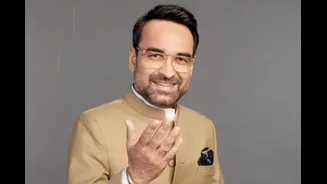









Pankaj Tripathi may be preparing to take his first steps behind the camera. Speaking at the News18 Rising Bharat Summit North Edition in Lucknow, the actor said he has been looking for a story he can direct,
one shaped by the places, people and sounds he grew up around. Rather than arriving with a ready script or a declared project, he spoke about an urge to tell something unmistakably his own.
The conversation also offered a glimpse of how Tripathi is looking at the next phase of his career. He discussed the remaining seasons of Mirzapur and Criminal Justice, the need to examine oneself after achieving success, and why the artist within him continues to feel restless even when he is content with his life. He also explained the acting lessons behind his celebrated silences and why biopics, in his view, can be difficult to get right.
The Film He Wants To Make Would Sound Like The World He Knows
Asked whether he was considering direction, Tripathi did not rule it out. “I think I’ll move towards direction soon,” he said, adding, “I’m searching for a story. I’m looking for a story that comes from somewhere within me.” His reason was simple: he wants to tell certain stories in his own way, rather than make a film merely for the sake of becoming a director.
To explain what he meant, the actor reached back to the sounds of his childhood. He recalled rainwater dripping from the edges of a village house and the distinctive rhythm it produced. There was also the sound of the flour mill, which he imitated as he spoke, and the familiar noise of the traditional grinding stone. These were not incidental details for him. They were elements of everyday life that he felt were largely missing from the cinema he watched.
“I don’t hear that sound in cinema,” he said of the rainwater falling from the roof. The memory led him to describe the filmmaking sensibility he hopes to develop: “I want to make cinema that belongs to my world. Cinema where the landscapes are familiar to me. Where the soundscape is familiar to me. Where the characters are people I recognise.”
That does not necessarily mean a film set exclusively in a village. Tripathi pointed out that a substantial part of his life has been spent in cities, and those experiences would inevitably find their way into his work. He suggested that his eventual story could combine rural and urban worlds, although he was careful to say that nothing had been decided yet.
One influence he was more certain about was satire. Tripathi spoke fondly of Shrilal Shukla’s novel Raag Darbari, calling it one of his favourites. “I really enjoy satire,” he said, indicating that the form may have a place in whatever he directs. “There will probably be an element of satire in whatever I make.” For now, however, the search for the right subject continues. He did not announce a title, cast or shooting schedule.
What Comes After Mirzapur And Criminal Justice?
The possibility of direction surfaced as Tripathi reflected on the acting commitments still ahead of him. When asked whether he wanted to move away from the worlds of Mirzapur and his other long-running series, he pointed to the nature of streaming shows, where characters return across successive seasons.
“As far as Mirzapur is concerned, there’s still one season remaining. And with Criminal Justice, there are still two seasons remaining,” he said. “So, I’ll complete those three seasons. After that, we’ll embark on some new journeys.” His remarks described his own expectations about those series rather than announcing release dates or production schedules.
He imagined the next stretch of his life including travel, new experiences and, naturally, food. He spoke about exploring different corners of India and trying the food found there. Yet, despite his willingness to slow down, Tripathi rejected the suggestion that he might lose interest in performing altogether.
“The person is satisfied, but the artist is still restless,” he said. “The artist within me will never be completely satisfied. The day that artist becomes entirely satisfied, my journey as an artist will be practically over.” To him, a degree of dissatisfaction is not a burden to be eliminated but part of what keeps a performer alert and curious.
He also resisted framing his career around one extraordinary breakthrough. When asked if a single incident had transformed his life, Tripathi compared his journey to a mountain stream finding its way downhill through a series of small turns. He then offered another image: water dripping slowly from a leaking earthen pot into a vessel placed underneath it. Each small acting part was a drop, he suggested, until those accumulated drops became recognisable characters such as Kaleen Bhaiya in Mirzapur and Madhav Mishra in Criminal Justice.
The fame those characters brought him has not, he insisted, changed his understanding of the work. There are still parts of himself he wants to explore as an actor, and stories he wants to tell. Becoming a director appears to be an extension of that curiosity, not a farewell to acting.
Why Success Has Made Him Question Himself
Tripathi was equally candid when the discussion turned to money. Asked whether the excitement of acting still drove him or whether the arrival of bigger cheques had become a motivation in itself, he responded with a pun that carried a serious warning. “Once the cheques start coming in, a person often stops checking himself,” he said.
He was referring to self-evaluation, the habit of asking whether success has quietly altered one’s behaviour. “You have to ask yourself, ‘Has arrogance crept into me?'” he explained. In his view, money and public recognition can bring ego with them, and the change may be difficult to identify because arrogance often presents itself as self-respect. What someone believes is a defence of their dignity may, without reflection, become a reason to look down on others.
Tripathi stressed that he was not dismissing the importance of money. “Money is extremely important. Extremely important. I’m not denying that at all,” he said. He even joked that he had once been a poor philosopher, whereas now he had money and continued to philosophise. The views, he added, were not newly acquired after becoming successful; he had held them for years, only without an audience asking him about them.
The actor questioned the pressure to make every aspect of life faster, from eating and sleeping to attaining success. He observed that people chase achievement at breakneck speed only to spend large sums at wellness centres learning to slow down, eat mindfully and establish a healthier routine. He also expressed frustration with the hold mobile phones have acquired over everyday life. “It originally came into our lives so that we could operate it. But now it has begun operating us,” he remarked.
For Tripathi, the point of earning money is to make life easier, not to turn comfort into another source of anxiety. Using a characteristically earthy example, he said that however large a house becomes, a person still needs only a six-by-six-foot bed to sleep in. The pursuit of a bigger house, he suggested, should not come at the cost of sleep itself.
That interest in a quieter, more deliberate life has also taken him outside films. Tripathi said he has begun working on a small handloom initiative that brings together fabrics woven in Bihar, Karnataka and Gujarat, with an emphasis on natural dyes. His affection for khadi and handloom textiles was part of the impulse. He also described an audio storytelling startup called Velvet, inspired by evenings when his grandmother would tell him stories and ask the children to keep responding with a ‘hmm’ so she knew they were awake.
With grandparents often living far from young children in nuclear families, he hopes such stories can recreate some of that intimacy without another screen being switched on. The idea is for families to listen together, perhaps as children fall asleep. It was one more example of the experiences he wants to carry forward, even as the medium changes.
On His Famous Pauses And The Problem With Biopics
Tripathi also used the session to explain a feature of his performances that audiences frequently associate with him: the ability to make silence expressive. Asked whether his restrained dialogue delivery was instinctive or deliberately developed, he credited his acting training rather than treating it as an inexplicable personal gift.
He recalled being taught that a pause in a scene should never be empty. In acting terminology, he explained, a ‘pregnant pause’ holds thought or feeling even when the character has stopped speaking. He distinguished between the text, the words actually written in a script, and the subtext, the meaning underneath them. A beginner may stop talking without knowing what occupies that silence; a trained actor must give it purpose.
Another lesson has stayed with him: “Through minimum, create maximum.” Whether deciding how far to lift a hand or how softly to deliver a line, an actor should understand the economy of movement. Tripathi demonstrated how a quiet “You understand, don’t you?” can sometimes carry greater weight than the same words delivered with force. His understated style, he suggested, rests on such choices rather than on the absence of technique.
The actor was less enthusiastic about the prospect of starring in a biopic. His reservation concerned the way life stories are often presented in Indian cinema. “We tend to concentrate only on the positive qualities of the person whose life we’re portraying,” he said, arguing that films should allow room for criticism and flaws as well as achievement.
He pointed out two different challenges. A biopic about a widely recognised public figure can invite expectations of mimicry, with attention fixed on how accurately an actor reproduces the person’s face, voice and gestures. A film about a less visually familiar achiever can fall into the opposite trap, turning into uninterrupted glorification. “We need to examine a person in their entirety,” he said. “That includes their strengths, but it should also include their weaknesses.” He added that the same principle should apply if anyone ever made a film about him.
For the moment, Tripathi is continuing to act while considering what he might eventually direct. His latest release, Parivarik ManuRanjan, also came up during the conversation. The Lucknow-set romantic comedy, directed by Varun V Sharma, premiered on SonyLIV on November 13, 2026. The film stars Tripathi as Ranjan Dubey, an unmarried man living alone in his sprawling ancestral home, whose routine changes when Helen, played by Aditi Rao Hydari, arrives to manage his household. Also featuring Brijendra Kala, Mukesh Tiwari and Sunita Rajwar, the film explores an unconventional romance through humour, everyday situations and family complications. At the summit, Tripathi described its simple, family-oriented storytelling as ‘sattvic cinema’, comparing it to the comfort of home-cooked food after several days of restaurant meals.