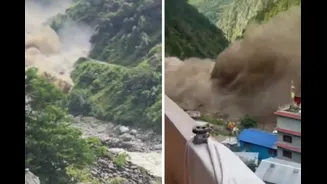





At least seven people have been killed and more than 40 security personnel are missing after a massive flash flood tore through Nepal’s Rasuwa district on Wednesday, August 26, sweeping away settlements,
bridges and infrastructure near the country’s border with Tibet. The scale of the disaster is still unfolding, with rescue teams struggling to reach some of the worst-hit areas as raging waters and damaged roads hamper operations.
The flooding struck areas including Timure and Syapru Besi along the Bhote Koshi river, with officials warning of further casualties. Nepal Prime Minister Balendra Shah said rescue and relief teams, including the security forces, had been mobilised and directed authorities to move people from vulnerable lower-lying areas to safer locations.
“Instructions have been given to move the people living in the lower areas to safer places,” Shah said, urging people living along the river to remain alert.
Rasuwa district administrator Narendra Pariyar also warned that there could be “heavy casualties or loss of property”, although the exact scale of the disaster was not immediately known.
The suddenness of the flood has added to the alarm. A local witness described hearing a sound “like a volcano erupting” before people began screaming and running for safety.
Pariyar said officials had seen a sudden flood and were still trying to establish what caused it. “The exact details have not come yet,” he said, while noting that officials were investigating whether a glacial lake had burst upstream.
What Is A Glacial Lake Outburst Flood?
A Glacial Lake Outburst Flood happens when water stored in a lake formed by melting glacier ice is suddenly released.
As glaciers retreat, meltwater can collect in depressions or behind natural dams made of rocks, ice and glacial debris. These lakes can grow rapidly. If the natural barrier collapses, because of heavy rainfall, an avalanche, landslide, icefall, erosion or other instability, enormous quantities of water can be released almost instantly.
The resulting flood is very different from an ordinary river flood. It can rush down a steep Himalayan valley carrying boulders, mud, trees and debris, destroying bridges, roads, homes and power infrastructure in its path.
And the flood does not have to originate where the destruction occurs. A lake or glacier many kilometres upstream can burst and send a wall of water downstream into communities that may have experienced little or no rain themselves.
Nepal Has Seen This Before
On July 8, 2025, a devastating flood swept down the Bhote Koshi from the Tibet side into Rasuwa. At least nine people were killed and more than two dozen were reported missing. The flood washed away the Friendship Bridge connecting Nepal and China and damaged the Rasuwagadhi hydropower project and other infrastructure.
Days later, satellite analysis by the International Centre for Integrated Mountain Development, or ICIMOD, established that the flood had been triggered by the drainage of a supraglacial lake in Tibet.
Nepal has also witnessed other major GLOFs. On August 16, 2024, a glacial lake outburst from the Thyanbo glacial lake struck Thame in the Everest region. ICIMOD confirmed the event as a GLOF. Later research found that the disaster involved a complex chain reaction in which a rock avalanche displaced water and contributed to the failure of another glacial lake, sending water and debris downstream.
The threat extends beyond Nepal. On October 4, 2023, the South Lhonak glacial lake in Sikkim burst, triggering catastrophic flooding and killing at least 40 people, with dozens more missing in the aftermath.
Why These Floods Are A Warning
For the August 26 Rasuwa flood, officials have not yet established that a GLOF was responsible. Heavy rainfall upstream, a landslide or another sudden release of water remain possibilities.
But the region’s recent history shows why investigators are looking towards the high Himalayas.
With glaciers retreating and glacial lakes expanding, the risk is no longer confined to remote ice fields. A sudden event high in Tibet can become a disaster downstream in Nepal within hours, and potentially affect river systems farther downstream.
For communities living along the Bhote Koshi and Trishuli, Wednesday’s flood is therefore more than another monsoon disaster. It is another warning that in the Himalayas, the most dangerous flood may begin far beyond where the water eventually strikes.