








If you are planning a Thailand getaway after April 27, you may want to rethink your budget. The Royal Thai Embassy in New Delhi and consulates across India will implement significantly revised visa, legalisation,
and consular fees. While the popular 60-day visa exemption for Indian tourists remains unchanged for short leisure trips, anyone requiring a proper visa will face noticeably higher costs.
The updates affect a wide range of visa categories, from standard tourist visas to long-term options favoured by digital nomads, professionals, and investors. Travellers applying for anything beyond the visa-free entry will now pay more at Indian Thai diplomatic missions.
What Is The Revised Fee Structure for Thailand Visa?
Thailand has revised its visa and consular fee system across multiple categories, and the update applies to travellers applying after 27 April. The changes affect tourist visas, business visas, and long-term stays, making some trips noticeably more expensive than before.
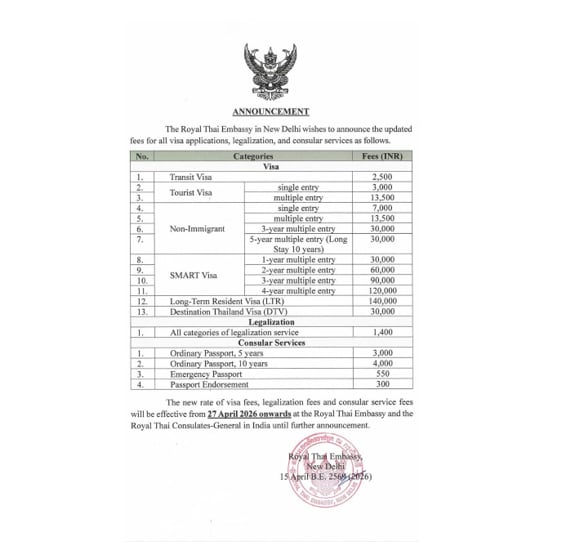
The updates affect a wide range of visa categories, from standard tourist visas to long-term options favoured by digital nomads, professionals, and investors. Travellers applying for anything beyond the visa-free entry will now pay more at Indian Thai diplomatic missions.
- New Thailand Visa Fees (Effective 27 April 2026)The Transit Visa will now cost INR 2,500.
- The Tourist Visa will be priced at INR 3,000 for a single entry and INR 13,500 for a multiple-entry option.
- The Non-Immigrant Visa will start at INR 7,000 for a single entry, with longer multiple-entry options going up to INR 30,000.
- The SMART Visa, designed for skilled professionals, investors, and startups, will cost INR 30,000 for a 1-year multiple entry, INR 60,000 for 2 years, INR 90,000 for 3 years, and INR 1,20,000 for 4 years.
- The Destination Thailand Visa (DTV) will be available for INR 30,000.
- The Long-Term Resident (LTR) Visa will now cost INR 1,40,000.
How This Affects Indian Travellers?
For the average Indian traveller heading for a two-week holiday, the impact is minimal. However, frequent travellers, remote workers applying for the DTV, or those seeking longer stays will feel the pinch. The higher fees for SMART and LTR visas could particularly affect professionals and entrepreneurs who previously benefited from Thailand’s long-stay programmes.
Travel experts recommend applying early through the official channels to avoid last-minute surprises. Always check the Royal Thai Embassy website for the latest updates, as processing times and additional documentation requirements may vary.
Smart Tips Before You Fly
- Confirm whether your trip qualifies for the 60-day visa exemption.
- Budget extra for any potential extensions or future long-stay plans.
- Consider travel insurance that covers trip disruptions and medical emergencies, Thailand’s healthcare is excellent but can be costly for foreigners.
- Book flights and hotels flexibly, as rules around entry fees or digital systems can evolve quickly.