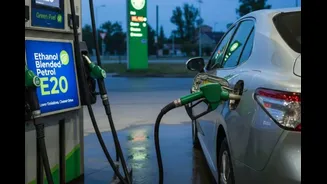








Amid growing consumer concerns over E20 petrol, the Centre is examining whether existing premium fuel variants such as Indian Oil’s XP95, BPCL’s Speed and HPCL’s Power95 can be offered with a 10% ethanol
blend, potentially creating an E10 option without requiring new storage and dispensing infrastructure at fuel stations, according to a report published in Livemint.
According to the report, the Petroleum Ministry is discussing the proposal with state-owned oil marketing companies – Indian Oil, Bharat Petroleum and Hindustan Petroleum.
Also Read: ‘Bring Back E10 For Older Vehicles’: CEA Nageswaran’s Surprise Suggestion Amid Centre’s Push For E20 Petrol
The discussions come as motorists, particularly owners of older petrol vehicles, have raised concerns over the mileage issues and negative impact of E20 petrol on their cars. Calls for the return of E10 petrol have consequently gained traction.
Can E10 Petrol Return?
According to the report, E10 is expected to make a comeback soon, although it has not yet been decided whether it would be sold as regular petrol or as a premium product.
“Options are being looked at in order to offer the more appropriate E10 fuel for older vehicles and allay the consumer concerns. Octane 95, which comes at a premium, is among the options being considered to be offered as E10,” said an official to Livemint.
The government and oil companies are also assessing whether motorists would be willing to pay a premium for E10 fuel or whether demand would favour a cheaper, regular version.
“So, it is being looked at if a regular, cheaper E10 would be more acceptable or an expensive, premium E10,” as per the official.
The proposal remains at an early stage, and no final decision has been taken.
What Nitin Gadkari Said About E20?
Road Transport and Highways Minister Nitin Gadkari has acknowledged that moving to E20 can have an impact on fuel economy, with the extent varying according to the vehicle and its age.
“The fuel efficiency of vehicles may be reduced by 2 to 6% depending on the vehicle category and vintage. The tests for engine durability on a dynamometer and vehicle tests on road have not shown any failures due to E20,” the minister said in a written reply to the Lok Sabha.
Gadkari also said tests had found benefits from E20, including better acceleration and ride quality, along with around 30% lower carbon emissions compared with E10.
All About High-Octane Petrol Variants
Premium 95-octane fuels currently cost significantly more than regular petrol in Delhi. XP95, Speed and Power95 are priced at roughly Rs 110-115 per litre, while regular petrol costs around Rs 102 per litre.
Also Read: ‘No Cause For Alarm’: Oil Firms Say E20 Petrol Meets Quality Standards, Junk Contamination Claims
Despite the higher price, demand for these fuels has risen sharply amid concerns surrounding E20. Their share of total petrol sales by oil marketing companies has reportedly increased to around 15%, from about 4% in March.
The premium fuels currently sold in India, however, are not an E10 alternative. They contain the same 20% ethanol blend as regular petrol but also include additives intended to improve combustion, clean engine components, protect against corrosion and enhance performance.
They are available at around 90,000 public-sector fuel stations.
A more expensive Octane 100 option is also available for luxury vehicles. It costs approximately Rs 150-170 per litre and, unlike the other premium variants, contains no ethanol.
What Has Centre Said On E10’s Comeback?
The Centre has previously rejected the idea of requiring petrol pumps to stock multiple ethanol blends simultaneously.
In a July 10 statement, the Ministry of Petroleum and Natural Gas said that asking pumps to offer petrol with different ethanol concentrations “ignores the realities of India’s fuel distribution network”.
The ministry said maintaining separate nationwide streams for different blends could increase logistics and handling costs, complicate inventories and affect efficiency.
It also distinguished premium petrol from a nationwide E10 rollout.
“Premium fuels are niche products sold in limited quantities at a significant price premium because specialised performance-enhancing additives are blended into them. They are not separate nationwide base fuel streams. Running parallel nationwide supply chains for pure petrol, E10, and E20 would be an entirely different proposition,” the ministry said.