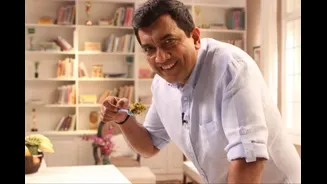



For decades, Sanjeev Kapoor has been one of the most recognisable faces shaping how India cooks, eats, and understands its own culinary identity. From bringing regional flavours into mainstream conversation
through Khana Khazana to building a global food empire, his journey mirrors the evolution of Indian cuisine itself.
But beyond the recipes and restaurants, Sanjeev Kapoor sees food as something far more layered – an expression of memory, culture, and connection. In this candid conversation with News18, he reflects on how Indian food became a storytelling medium, why the North East deserves global attention, and the delicate balance between technology and tradition in modern kitchens.
You’ve spent decades bringing Indian cuisine to global audiences – from television to cookbooks to restaurants. Looking back, what single moment made you realise that food could be a vehicle for cultural storytelling, not just nourishment?
I don’t think there was one single moment. It has really been a slow realisation of many experiences that have built up over time. When I first started, I was simply focused on cooking well and learning as much as I could. But as I travelled, interacted with people from around the world, and later began cooking on television, I started noticing that people weren’t just asking about the recipe. They were asking where it came from, who cooked it at home, and what occasion it was made for. It felt like they all wanted to understand the full story behind the dish.
I also believe I was fortunate to be at the right place at the right time. Opportunities came my way, and I chose to embrace them rather than hold back. Platforms like television allowed me to take Indian food into homes across the world, and that’s when it truly struck me that food has the power to connect cultures in a very meaningful way.
Indian cuisine is extraordinarily diverse, yet it’s often reduced to a handful of dishes abroad. As someone who has worked tirelessly to change that narrative, what regional dish or culinary tradition do you feel deserves far more international recognition?
If I had to point in one direction, it would be the North East of India, not just a single dish, but the entire culinary approach. There’s something about the food from this region that has always fascinated me. It never fails to surprise me with how simple yet deeply flavourful it can be. What stands out is how different it is from what most people outside India imagine Indian food to be. The flavours are clean, the ingredients are hyper-local, and there’s a strong reliance on techniques like fermentation and smoking, which give the food its own distinct identity.
Which Indian ingredient do you believe could be the next “global superfood” if positioned right?
India has a treasure trove of ingredients that have been part of our traditional diets for centuries. Millets are already gaining well-deserved global attention, but beyond that, I believe ingredients like moringa and amaranth have immense potential. They are highly nutritious, versatile, and align perfectly with the global shift towards healthier and more sustainable eating. What’s important is how we present and position these ingredients, not just as something traditional, but as something relevant and exciting for today’s world.
View this post on Instagram
If you had to remove one widely accepted “rule” in Indian cooking, what would you break without hesitation?
If there’s one thing I would change, it’s the idea of keeping recipes a secret. There was a time when chefs didn’t like sharing their recipes because they felt it gave them an advantage. I never really believed in that. Food is meant to be shared, not just on the plate, but the knowledge behind it as well. I’ve always felt that when you share what you know, you don’t lose anything; you only learn and grow more.
You’ve mentored and inspired an entire generation of chefs and home cooks through Khana Khazana and beyond. What is the one piece of advice you find yourself repeating most often, something you wish you had been told earlier in your own career?
One thing I find myself saying again and again is, share what you know and never stop learning. When I started, there was a very different mindset in kitchens. Recipes were often treated like secrets, something to be protected rather than passed on. Over time, I realised that this only limits growth, not just for an individual, but for the entire culinary space.
The more you share, the more you open yourself up to new ideas, new perspectives, and even better ways of doing things. I’ve learned as much from others as I have from my own experiences. Being open, staying curious, and continuing to learn, no matter how much you know, is what truly helps you grow.
You’ve seen Indian kitchens evolve from pressure cookers and handwritten recipes to air fryers and AI-led cooking apps. Do you think technology is enhancing our relationship with food, or quietly distancing us from it?
I think it’s doing a bit of both, and that’s the reality with any kind of change. On one hand, technology has made cooking far more accessible. Today, someone who may have never cooked before can follow a recipe online, watch a video, or use an app and feel confident enough to try.
At the same time, there is a risk. When everything becomes too quick or too automated, we can start losing that personal connection, the understanding of ingredients, and the instinct that comes with experience. For me, the answer lies in balance. Use technology to make things easier, but don’t let it replace the joy of cooking with your own hands, tasting as you go, and truly engaging with the process.
Do you think India has done enough to document and preserve its culinary heritage, or are we at risk of losing recipes faster than we’re rediscovering them?
We have definitely made a start, but there is still a long way to go. India’s culinary heritage is incredibly vast and diverse, and a large part of it still exists in home kitchens, passed down through generations by word of mouth. That’s what makes it so special, but also what makes it vulnerable.
If these recipes are not documented or practised regularly, they can easily fade away. Documentation is important, but equally important is keeping these recipes alive by continuing to cook them.
After everything you’ve built – from Khana Khazana to Wonderchef – what still excites you about stepping into a kitchen today?
What excites me the most is something very simple: the joy of cooking for someone who truly enjoys food. There’s a very special feeling in watching someone taste what you’ve made and seeing that moment of happiness on their face.
At the same time, I still enjoy the process of discovery. Even today, there are new ingredients to explore, new combinations to try, and new ways to look at familiar dishes. That curiosity is still very much alive in me. For me, the kitchen has never felt like a routine space. It’s always been a place where something new can happen, and I think that’s what continues to excite me every single day.