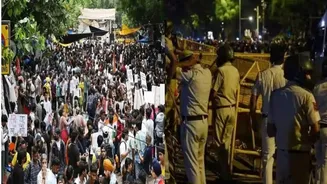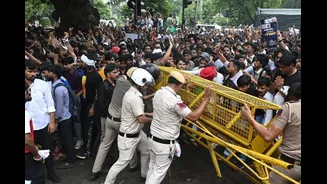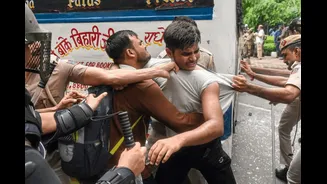









The use of pellet guns and other non-lethal crowd-control measures during the July 20 Cockroach Janta Party’s (CJP) ‘Chalo Sansad’ protest at Delhi’s Jantar Mantar was authorised by Delhi Police and carried
out in accordance with standard operating procedures (SOPs), according to a post-event review by the Central Reserve Police Force (CRPF) accessed by The Times Of India.
The CJP had organised the ‘Chalo Sansad’ march amid protests over the NEET-UG paper leak controversy, which had left lakhs of students affected nationwide.
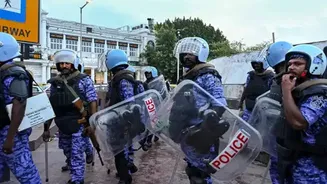
According to the review, the Rapid Action Force (RAF), the CRPF’s specialised anti-riot unit, followed the prescribed “force gradient” while responding to violence during the protest, resorting to pump action guns firing pellet rounds only after lower-intensity crowd-control measures failed to disperse the mob, the TOI reported.
CRPF sources said the review concluded that public announcements, tear gas and lathi charge were used before non-lethal pellet rounds were fired.
Around three to five protesters sustained injuries from metal pellets during the clashes, while 47 RAF personnel were injured, including six who suffered head injuries, the report stated.
According to the report, the CRPF said that use of force on July 20 was authorised by Delhi Police and complied with both the law and established operating procedures.
Also Read: Was A Stone-Laden Truck Parked Near Jantar Mantar Before CJP’s July 20 Rally? Delhi Police Clarifies Claim
Sources also alleged that some “motivated elements” in the crowd attacked Delhi Police and RAF personnel with stones and, in certain instances, iron rails during the violence.
Who Can Authorise Use Of Civil Force During Protest?
Under the Bharatiya Nagarik Suraksha Sanhita (BNSS), an executive magistrate may order the use of civil force to disperse an unlawful assembly after assessing the situation.
In Delhi, this authority rests with the Police Commissioner and is delegated to officers up to the rank of Assistant Commissioner of Police (ACP).
Explaining the authorisation process, a CRPF officer said, “RAF deployed at protest sites uses anti-riot gear only with authorisation, which in this case came from the DCP/ACP in charge of the protest site. Such authorisation is in writing and as per a format used at all sites of unlawful assembly; no order is given verbally.”
Officials also reiterated that pump action guns are recognised as a non-lethal crowd-control measure under established protocols.
“Their use, with the force gradient being followed and under authorisation by the competent officer, is as per the SOP,” another officer said, while speaking to TOI.
What Happened In July 20 Protest?
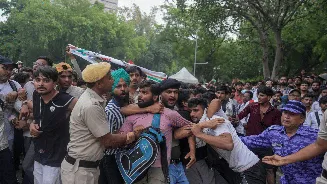
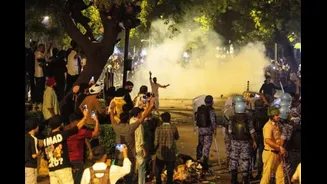
Violence erupted during the CJP ‘Chalo Sansad’ protest on July 20, with clashes breaking out between demonstrators and security personnel at multiple locations around Jantar Mantar and nearby areas.
According to Delhi Police, more than 65 protesters and over 200 police personnel were injured in the unrest. The alleged use of plastic pellets by security forces during the operation later became a major political flashpoint after reports claimed that several protesters had sustained grievous injuries.
Also Read: CJP Protest Violence: 3 Attempt To Murder, 12 Rioting Cases Among 20 FIRs Filed By Delhi Police
Amid the controversy, a high-level meeting was held at the Delhi Police headquarters on Tuesday to discuss a general diary (GD) entry made at Parliament Street police station regarding the use of non-lethal munitions by the Rapid Action Force (RAF).
According to official records, the RAF fired 55 non-electrical shells, 15 electrical shells, five tear smoke grenades, two rounds from anti-riot guns and two rounds of plastic pellets while dispersing the crowd.
Police officials said each round of plastic pellets contains four plastic projectiles designed to cause less serious injuries than metal pellets.
Delhi Police has, however, maintained that claims of pellet guns being used against protesters are “false and misleading”, reiterating the same position in a statement posted on its official X handle.
CJP Warns Of Fresh Protests
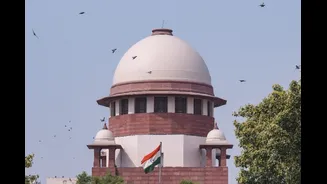
The CJP on Tuesday threatened to launch a fresh nationwide agitation, accusing the Centre of reneging on assurances given during talks by citing the Supreme Court’s interim order in the batch of petitions related to the July 20 protest.
The outfit alleged that the government had failed to provide a written commitment on withdrawing FIRs lodged against protesters, despite earlier agreeing to do so.
The latest warning comes just days after CJP ended its 36-day sit-in at Jantar Mantar, announcing that the Centre had accepted several of its key demands. These included the resignation of then Union Education Minister Dharmendra Pradhan, withdrawal of FIRs against protesters, protection from retaliatory action and a commitment to examine wider reforms in the examination system.