





With winter knocking on the door, Delhi’s air quality is steadily worsening, posing serious health risks to residents. Local emission sources and stubble burning in neighbouring states contributed to the air pollution
in the capital, prompting authorities to initiate measures to curb the same.
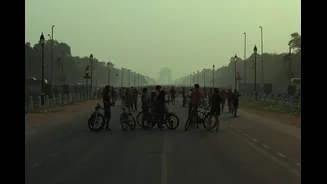
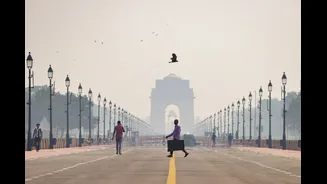
The Air Quality Index (AQI) in the area around India Gate was recorded at 403, placing it in the ‘severe’ category. Authorities have deployed truck-mounted water sprinklers to mitigate air pollution.
#WATCH | Delhi: Air Quality Index (AQI) in the area around India Gate is 403, categorised as ‘Severe’, as per the CPCB (Central Pollution Control Board).
Municipal authorities deploy truck-mounted water sprinklers to undertake water sprinkling operations as Stage-II Graded Response Action Plan (GRAP-II) enforced across the region.
(Visuals shot at 07:05 am)
— ANI (@ANI) November 6, 2026
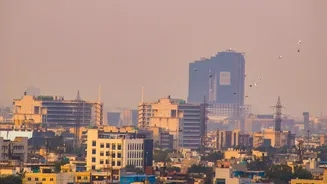
The AQI in the area around Anand Vihar stood at 350 on Friday, placing it in the ‘very poor’ category, according to the Central Pollution Control Board (CPCB).
#WATCH | Delhi: Air Quality Index (AQI) in the area around Anand Vihar is 350, categorised as ‘Very Poor’, as per the CPCB (Central Pollution Control Board).
(Visuals shot at 6:20 am) https://t.co/ElXxQlZ1Nj
— ANI (@ANI) November 6, 2026
Meanwhile, the 24-hour average was recorded at 369 on Thursday, according to the Central Pollution Control Board (CPCB), just 8 points lower than Wednesday’s 377.
An AQI between 0 and 50 is classified as ‘good’, 51-100 as ‘satisfactory’, 101-200 as ‘moderate’, 201-300 as ‘poor’, 301-400 as ‘very poor’ and 401-500 as ‘severe’.
Delhi’s AQI To Dip To ‘Severe’
According to the Air Quality Early Warning System (AQEWS), Delhi’s air quality will deteriorate to the ‘severe’ category from Friday through Sunday. The outlook for the subsequent six days is also expected to remain between the two categories.
On Thursday, of the 59 active air quality monitoring stations in Delhi, 22 showed “severe” air quality. Punjabi Bagh recorded the highest AQI of 459, followed by Jahangirpuri (457), Rohini (453), IIT Delhi (452) and DTU (443).
Sources Of Pollution
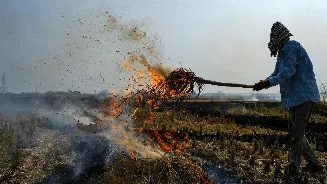
Stubble burning accounted for an estimated 15.6 per cent of Delhi’s PM2.5 pollution on Thursday, according to the Decision Support System (DSS) for Air Quality Management. The contribution is expected to rise to 19.2 per cent on Friday before falling sharply to 1.6 per cent on Saturday.
In contrast, transport emissions are projected to play a larger role in the coming days, with their share rising from 17.9 per cent on Thursday to 18.3 per cent on Friday and 21.1 per cent on Saturday, the DSS said.