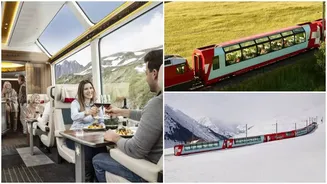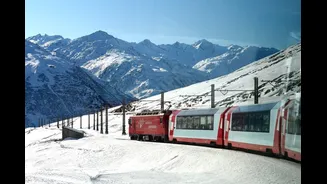





A train journey through the Swiss Alps is drawing attention not for speed, but for time – and the price. The Glacier Express, which runs between Zermatt and St. Moritz, takes about eight hours to complete
its route. A top-tier seat on this train can cost close to Rs 1 lakh – depending on class and reservation.
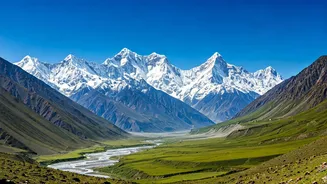
The Glacier Express, often described as the slowest express train in the world, crosses 291 bridges and passes through 91 tunnels along the way. The line cuts through mountain passes, deep valleys and high-altitude landscapes that remain snow-covered for much of the year.
The Glacier Express: A railway with more than a century behind it
The rail lines that form this route date back to the early 1900s. While parts of the network opened in 1904, the first Glacier Express service linking Zermatt and St. Moritz ran in 1930. Early operations faced winter shutdowns because of avalanche risks on the Furka section. That changed in 1982, when the Furka Base Tunnel opened, allowing year-round travel.
The route is part of a railway system later recognised as a UNESCO World Heritage Site. Over time, upgrades focused on the view. Panoramic coaches were added in the 1990s, with further expansions in 2005 to mark the train’s 75th year. Interiors in several classes were refurbished again in 2021.
A statement on the train’s official platform notes that alongside European travellers, more Asian visitors are now discovering the route.
Glacier Express ticket prices and travel classes
Travel on the Glacier Express requires both a train ticket and a mandatory seat reservation:
- Second Class tickets costs CHF 213 total (around Rs 25,000)
- First Class tickets cost CHF 326 total (around Rs 39,000)
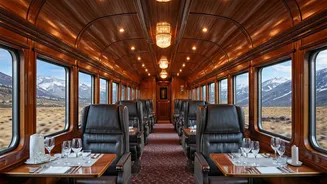
- Excellence Class costs CHF 812 total (around Rs 97,000)
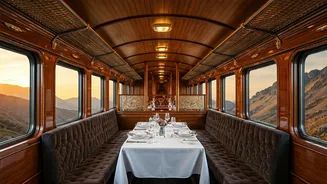
- The Excellence Class, introduced in 2019, includes upgraded interiors and service elements aimed at luxury travellers.
Why this slow Alpine train journey stands out
The trip is not built around speed. It is about distance covered slowly, large windows, and long stretches between alpine towns. For many passengers, the appeal lies in the route itself rather than the destination.