
When Kantara was released in 2022, Rishab Shetty had no idea the film would turn into a nationwide phenomenon. This deep-rooted story from coastal Karnataka went on to win hearts across the country, eventually
earning Rishab a National Award for Best Actor.
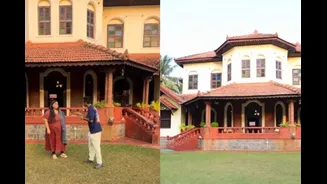
The film introduced audiences to Bhuta Kola, a powerful traditional form of worship and built a world so immersive that viewers still remember its smallest details. If you recall the film clearly, you will remember Devendra Suttooru, the village landlord descended from royalty. His ancestral home features in one of the most intense moments of the film, where Rishab’s character Shiva confronts him over his cousin, Guruva’s death. That very house exists in real life, and now, viewers get a rare look inside it.
Inside Kantara’s Ancestral Home
Recently, content creator Priyam Saraswat shared a video on Instagram that offers an inside tour of the house located in Udupi, Karnataka. The heritage property is maintained by Sai Radha Heritage.
“I think I have seen this house in the movie Kantara?” Priyam asks a woman who guides him through the space.
As the tour begins, she first shows the sitting room. Its walls are lined with antiques, including an image of Panjurli, the forest deity who protects the villagers in the film. The detailing across the house stands out immediately, which shows the care with which it was built.
The Table From Kantara’s Climactic Scene
As they move further inside, they reach the table where the film’s key confrontation was shot.
“This is where Rishab Shetty and the villain in the movie were seated,” the woman explains.
When asked what such a house is traditionally called, she responds, “It’s called Guthu Mane, which means ancestral house.” The structure follows a traditional layout, built around an open-to-sky courtyard. The living spaces, kitchen and bedrooms are arranged around this central area.
Architecture Rooted In Tradition
The woman also points out the double tiling on the roof, a natural cooling technique that reduces the need for air conditioning. They then step into the verandah locally known as “Ikat”.
“Landlords would come and talk to people who come to meet them,” she says.
The tour continues with a look at an ancient jewellery box with 30 compartments, followed by an accountant’s desk where daily records were once maintained. Old artefacts such as a piano and a fan are also shown.
The kitchen carries a rustic charm while the house has four bedrooms, two on the upper floor and two below. Kaavi art decorates parts of the walls and a well sits within the outside courtyard.
Towards the end of the video, Priyam asks, “What do you feel about keeping our ancient structures alive in the modern world we live in?” She replies, “It’s part of our heritage and tradition. It is very important to be connected to the roots. I think this is one such example.”
Kantara’s Journey Continues
Following the success of Kantara, Rishab returned with its prequel, Kantara: Chapter 1, last year. Set in 4th-century coastal Karnataka, the film follows tribal warrior Berme as he defends his people and their sacred forest from the Kadamba kingdom led by Prince Kulashekara. The film became a massive box-office success as it earned over Rs 800 crore worldwide.