
US President Donald Trump placed Greenland at the heart of his defence and foreign policy push, linking American control of the Arctic territory to his proposed “Golden Dome” missile defence system and broader
national security goals.
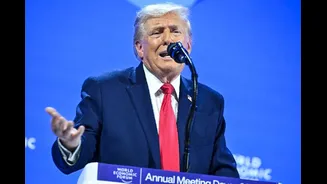
Speaking at the World Economic Forum in Davos, Trump projected Greenland as critical to Arctic stability, NATO security and future US military planning.
Trump argued that Greenland’s strategic location makes it indispensable for global security, claiming the vast Arctic island is “almost completely undefended” and asserting that only the United States has the capability to secure it.
He framed US involvement in Greenland as a necessity rather than a choice, insisting that Washington’s role would not undermine NATO.
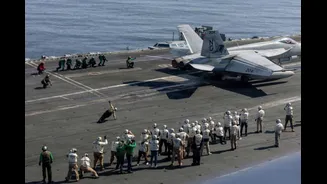
Unveiling what he described as a sweeping modernisation of American military power, Trump said the US defence budget has reached USD 1.5 trillion.
He outlined plans that include reviving battleships with vastly enhanced capabilities and building what he called the “biggest ever Golden Dome” missile defence shield, proposed to be based in Greenland to safeguard the Arctic region and North America.
According to Trump, the Greenland-based missile shield would extend protection beyond the United States.
“The Golden Dome in Greenland will also protect Canada,” he said, adding that Ottawa “should be more grateful” for the US security umbrella.
He indicated that further discussions on the project would follow, with Vice President JD Vance, Secretary of State Marco Rubio and Special Envoy Steve Witkoff tasked with leading talks and reporting directly to him.
In subsequent remarks and social media posts, Trump reiterated that Greenland is “vital for the Golden Dome we are building” and essential to US national security.
Earlier at the WEF summit, he had also called for immediate negotiations with European allies, maintaining that US control over Greenland would pose “no threat to NATO”.
Ex-US Army Officer Warns Trump
Trump’s ambitious defence vision has drawn sharp criticism from military experts, particularly over its feasibility against emerging weapons.
Former US Army officer and foreign policy analyst Daniel Davis dismissed the Golden Dome initiative as unrealistic, arguing that it cannot counter advanced hypersonic weapons such as Russia’s Oreshnik missile.
In an interview with ANI, Davis said intercepting the Oreshnik hypersonic missile is “impossible”, stressing that the technology required to stop it does not currently exist.
“There wasn’t even an attempt to intercept it when Russia demonstrated it because the speed is so extreme that existing systems don’t stand a chance,” he said.
Davis described the idea of an impenetrable missile shield as a “fool’s errand”, noting that offensive missile technology continues to evolve alongside defensive systems.
“Whatever you think you’ll build in the future, missile technology will move beyond it,” he said, pointing to real-world examples where advanced, layered air defence systems have failed to stop all incoming attacks.
Referring to last year’s conflict involving Israel and Iran, Davis noted that even Israel’s highly sophisticated, integrated air defence network, combining Iron Dome, THAAD, Patriot, David’s Sling and Arrow systems, was unable to prevent multiple missile strikes from getting through.
“That’s the best technology available today, and it still doesn’t stop it. It only slows some of it down,” he said.
Davis also ridiculed the notion of forcibly taking over Greenland, calling it “nonsensical” and “laughable”.
He argued that extending a fool-proof missile defence system across the continental United States, with or without Greenland, is “sheer fantasy” in an era dominated by hypersonic weapons.
Hypersonic cruise missiles, such as Russia’s Oreshnik, are capable of travelling at more than five times the speed of sound, over 6,100 km per hour, making detection and interception extremely difficult with current technology.