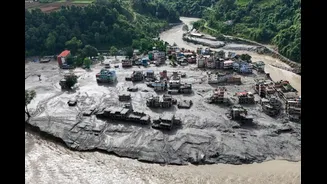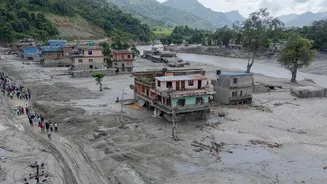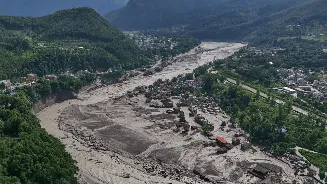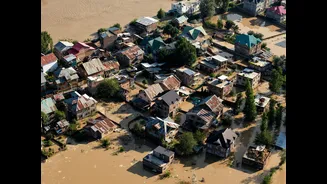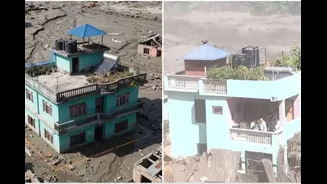







Videos of a green-coloured house standing amid the devastation caused by flash floods in Nepal have gone viral on social media, with the lone structure drawing attention after surrounding buildings were
swept away by the powerful torrent.
One possible explanation for the house’s survival has now been highlighted by Architecture Presentation in an explanation shared on X.
LIVE Updates On Nepal Floods
According to the account, the building’s construction, its location and its compact geometry may have helped it withstand the force of the debris flow.
The explanation is only one possible assessment of why the house survived, but it offers a structural perspective on the striking footage that has emerged from the disaster zone.
Nepal’s Green House Stands Amid Devastation
The video shows the house still standing while the area around it bears the impact of the devastating floods.
Architecture Presentation said the structure appeared to have taken a direct hit from a massive debris flow, describing the material as a dense slurry of mud and large boulders moving at high speed.
Despite the force of the flow, the house did not collapse.
The account said the survival could look like “pure luck”, but suggested that structural characteristics may have played an important role.
One of the possible reasons, according to the explanation, was the way the house had been constructed.
Reinforced Concrete Frame May Have Protected House
As explained by the X handle, many traditional homes in the Himalayan valleys rely on unreinforced stone masonry.
Such construction can handle vertical loads, but the account said powerful lateral forces can cause walls to fail and roofs to collapse inward.
The house, however, was described as having a reinforced concrete frame.
According to the explanation, continuous steel reinforcement connected the building’s columns, beams and foundation, effectively creating a single rigid structural framework.
This, it suggested, may have helped the house resist the sideways force generated by the debris flow.
Its Location May Have Also Helped
The position of the house could have been another possible factor in its survival.
The heaviest boulders in a debris flow are concentrated along the deepest central channel. The house, the account said, appeared to be positioned slightly away from that main path and on marginally higher ground.
Its compact shape may also have helped the floodwaters split and move around both sides of the structure.
Explanation into how this house survived Nepal flood. pic.twitter.com/DAHHG0BSyh
— Architecture Presentation (@arcpresentation) August 30, 2026
The explanation further suggested that mud deposited around the house quickly formed a natural ramp. This may have helped deflect later surges away from the building instead of allowing the full force of subsequent flows to hit it.
Family Was Earlier Seen Trapped In Floodwaters
The house is particularly striking in the context of earlier footage from the same disaster.
An earlier video report showed a family stranded on what appeared to be the balcony of a house as powerful flash floodwaters surged around the building.
At least three people could be seen on the upper-floor balcony, watching as muddy water and debris rushed around their home.
The footage captured the force of the flooding, with large quantities of muddy water flowing around the structure and debris being swept along in the current.
Sounds of panic and chaos could also be heard in the background.
The family appeared unable to leave as the waters continued to surge around the house.
The newly viral videos of the house now offer another view of the destruction, with the structure standing amid an area severely affected by the floods.
Nepal Floods Leave 781 Dead
The footage has emerged as the scale of the disaster continues to become clearer.
According to AFP, devastating floods near Nepal’s border with China had killed at least 781 people in Nepal, while 2,502 people were missing, as rescue operations continued for a fifth day.
Chinese state media had earlier confirmed 16 deaths in Tibet and 546 people missing following Wednesday’s disaster. The combined toll across Nepal and Tibet stood at 797 dead and 3,048 people unaccounted for.
Nepal’s missing list included 592 foreigners, AFP reported.
It also included 933 workers on hydropower projects along the river through which the torrent crashed, according to Nepal’s National Disaster Risk Reduction and Management Authority.
Nepal’s disaster agency separately listed 1,910 Nepali citizens as missing, including 562 people in the hardest-hit district of Rasuwa.
In India, authorities said they had recovered seven bodies from rivers flowing from Nepal, believed to be victims of the floods. Those deaths, however, were not included in Nepal’s toll.
Against the backdrop of this widespread destruction, the survival of the house has become a striking feature of the viral footage.
ALSO READ | Nepal Issues Fresh Flood Alert As Bhotekoshi River Rises; Phones Buzz With Warnings, Death Toll Nears 800