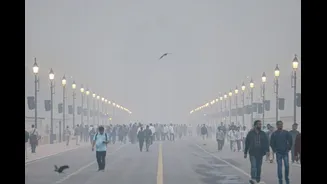

Residents of the national capital woke up to a hazy Sunday morning as a thick layer of toxic smog shrouded the city. Air quality further deteriorated, with the overall Air Quality Index (AQI) recorded
at 391 at 6 am, categorised as “very poor,” according to the Central Pollution Control Board (CPCB). In many areas, the air quality turned “severe” as the AQI crossed the 400-mark.
Visuals have emerged from several areas, including Anand Vihar, which were engulfed in toxic smog. The AQI in Anand Vihar was recorded at 445, categorised as “severe,” CPCB data showed.
#WATCH | Delhi: Visuals around the Anand Vihar area as a layer of toxic smog engulfs the national capital.
AQI (Air Quality Index) around the area is 445, categorised as ‘ Severe’, as claimed by CPCB (Central Pollution Control Board). pic.twitter.com/2qVLmTPNRR
— ANI (@ANI) December 28, 2025
Several Trains Delayed Due To Fog
As winter conditions tightened their grip across different parts of northern India, visibility reduced significantly, and normal life was disrupted, with many trains facing delays. Visuals have surfaced from New Delhi Railway Station, showing smog in the area.
VIDEO | Delhi: Several trains are running late as winter conditions, dense fog and smog persist across different parts of Northern India. Visuals from New Delhi Railway Station.#DelhiFog #TrainDelays #WinterConditions
(Full VIDEO available on PTI Videos –… pic.twitter.com/3D9TuiAaGq
— Press Trust of India (@PTI_News) December 28, 2025
Further, the Delhi airport issued a fog advisory for flyers, stating that all operations are continuing as usual. “All flight operations are continuing normally as visibility at the airport improves. Passengers are requested to contact their respective airlines for the latest flight information. Please be assured that our on-ground officials are available across all terminals to provide necessary support,” Delhi airport tweeted.
Passenger Advisory issued at 08:00 hours.
Please click on this link for real-time winter travel updates: https://t.co/Y0B6lhwIj4#DelhiAirport #PassengerAdvisory #DELAdvisory pic.twitter.com/bihfpuZo8D
— Delhi Airport (@DelhiAirport) December 28, 2025
Delhi Air Quality Deteriorates
Delhi’s AQI deteriorated sharply on Saturday evening, with the overall AQI touching 390. Several areas across Delhi-NCR recorded even worse air quality, with AQI levels crossing 400-mark. Patparganj registered an AQI of 431, while Shivaji Park recorded 400. Nehru Nagar saw the highest reading at 442, followed by Shadipur at 429. Sirifort reported an AQI of 402, and RK Puram recorded 412, indicating severe pollution levels across the region.
Delhi’s 24-hour average Air Quality Index (AQI) stood at 385 at 4 pm, in the ‘very poor’ category, compared to 332 on Friday. Earlier on Saturday morning, the air quality had shown some improvement, with AQI levels exceeding 300 in many areas.
The CPCB classifies AQI levels between 0 and 50 as ‘good’, 51-100 ‘satisfactory’, 101-200 ‘moderate’, 201-300 ‘poor’, 301-400 ‘very poor’ and 401-500 ‘severe’.
Authorities are monitoring pollution levels and enforcing measures such as the “No PUC, No Fuel” rule to address the situation. The Commission for Air Quality Management has invoked Stage III measures under the Graded Response Action Plan, including restrictions on construction and industrial activities.
A combination of cold weather, calm winds, and dense fog is trapping pollutants, leading to haze and smog. “Very poor” air quality requires people—especially vulnerable groups such as children, the elderly, and those with respiratory issues—to limit prolonged outdoor exposure and wear masks.