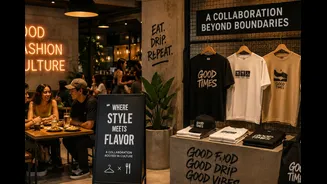








For Gen Z, brands aren’t just about products, they’re about experiences, identity, and cultural relevance. From dining spaces to streetwear drops, collaborations across industries are reshaping how young
consumers discover, engage with, and express themselves.
In a landscape where fashion, food, and culture increasingly overlap, collaborations are no longer a novelty, they’re strategy. The latest partnership between Snitch and PHURR is a telling example of how brands are moving beyond their traditional lanes to build something more immersive, more shareable, and ultimately, more relevant.
At the heart of this collaboration lies a shared sensibility, one that speaks directly to a young, culturally plugged-in audience. For Siddharth Dungarwal, founder and CEO, Snitch, the alignment was instinctive. PHURR’s identity as a space that is “young, quirky, and culturally in tune” mirrored Snitch’s own positioning in youth-driven fashion.
“This wasn’t just about fashion meeting another category,” he explains. “It was about coming together to create something that feels relevant to how our consumers live, socialise, and express themselves today.”
Where Style Meets Space
Streetwear, historically rooted in subcultures, is now being shaped by something far more fluid, lifestyle ecosystems. Where you eat, who you’re seen with, and how a space makes you feel are all becoming extensions of personal style.
Dungarwal points out that collaborations like these are shifting fashion from product to context. “Instead of just launching products, brands are creating experiences that people can be part of,” he says. “That’s where the shift is happening from standalone drops to more integrated, culture-led moments.”
This is where PHURR’s philosophy naturally intersects. For Rahul Lunawat, co-founder, PHURR, the idea of the restaurant as a purely functional space has long been outdated.
“PHURR was never meant to be just a place you come to eat,” he says. “The best dining spaces are the ones people connect with beyond the food, spaces that reflect a certain mood, a certain way of life.”
The Rise of Experience-First Brands
If there’s one clear shift defining today’s consumer landscape, it’s this: products alone are no longer enough. Dungarwal is unequivocal about this evolution. “It’s no longer optional, it’s essential,” he says. “What really drives engagement today are experiences and moments that people can relate to and share.” For Snitch, that means building consistent cultural touchpoints, whether through collaborations, retail environments, or other interventions that keep the brand embedded in everyday life.
For PHURR, extending into merchandise was a natural progression of that same thinking. Lunawat describes it as an effort to take the essence of the space beyond its physical boundaries.
“If people enjoy being at PHURR, how do we take a small part of that experience outside the space?” he says. “Merchandise felt like a natural way to do that but it had to feel authentic, not forced.”
That authenticity, he adds, came down to detail. Every design choice had to reflect the same personality that defines the dining experience, striking a careful balance between wearability and brand integrity.
Gen Z and the Culture of Belonging
Driving this shift is a generation that engages with brands very differently. For Gen Z, consumption is less transactional and more experiential and identity-driven.
“They don’t separate food, fashion, music, or culture the way they used to,” Lunawat observes. “It’s all part of one larger experience.”
This blurring of boundaries is precisely why cross-industry collaborations resonate. They allow consumers to engage with brands across multiple touchpoints, turning a meal into a memory, a T-shirt into a statement, and a space into a social currency.
“They’re drawn to brands that feel real, that have a point of view,” Lunawat adds. “That exist beyond just one interaction.”
From Drops to Cultural Moments
What emerges from collaborations like Snitch x PHURR is a broader industry shift from selling products to staging moments. Fashion is no longer confined to runways or racks; it lives in cafés, playlists, pop-ups, and now, plates.
And perhaps that’s the most telling takeaway: in today’s landscape, relevance isn’t built in isolation. It’s built at the intersection, where industries collide, cultures blend, and brands become part of how people live, not just what they wear. As Dungarwal puts it, the future lies in creating something that feels “part of the consumer’s everyday life.” Not just worn. Not just visited. But experienced.